Chapter 3: The Toast in the Rotunda
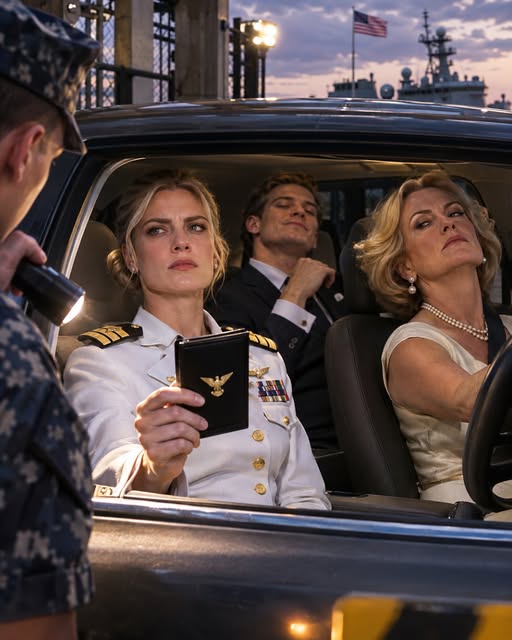
The rotunda of the flag pavilion was vaulted with dark cypress timbers, illuminated by brass ship lanterns that cast warm, amber circles across the polished terrazzo floor.
Eighty people stood in loose semicircles: naval captains, civil service directors, state senators, and foreign liaison officers from the NATO Atlantic Command.
When I entered the room, Captain Miller—a broad-shouldered naval aviator with graying temples—stopped mid-sentence with the district attorney.
""Attention on deck,"" Miller called out, his baritone cutting through the clink of crystal glasses.
The room snapped into silence.
Men in dress blues brought their heels together. Civilian guests stepped back, clearing a direct ten-foot lane from the heavy oak doors straight to the center of the rotunda.
I walked the lane alone.
I had left Marjorie and Wesley standing near the registration desk outside the glass doors, where two master-at-arms petty officers politely but immovably explained that civilian access to the flag rotunda required Tier-Two security clearance.
""Admiral Hale,"" Captain Miller said, stepping forward with his hand extended. ""We were worried you were delayed in Washington.""
""A minor transport complication, Thomas,"" I replied, taking his hand with a firm, practiced grip. ""The traffic on Route 17 was heavier than expected.""
""Understood, ma'am,"" Miller said, smiling. ""Allow me to introduce the State Transportation Commissioner, Mr. Douglas Vance. Doug, this is Rear Admiral Diana Hale. She commands the supply chain that keeps your ports dredged and your fuel depots filled.""
Douglas Vance was sixty-five, silver-haired, impeccably tailored, and wore the easy, relaxed smile of an old Virginia political patriarch.
""Admiral,"" Vance said, taking my hand. ""An honor. Your father, Frank Hale, was a master rigger at the Norfolk Naval Shipyard, wasn't he?""
I paused, my fingers still resting in his grip. ""He was. Thirty-four years in the structural machine shop.""
Vance’s smile widened, taking on a warm, personal nostalgia. ""Frank was a good man. Hard as cold iron, but honest. When I was a young assistant attorney for the port authority, Frank caught a six-million-dollar billing discrepancy on the dry-dock crane refits. A contractor had substituted substandard manganese alloy for high-tensile carbon steel. Frank refused to certify the cranes until the steel was replaced.""
A strange, hollow ring sounded in my ears.
""My father caught the discrepancy?"" I asked softly.
""He certainly did,"" Vance nodded. ""The contractor tried to buy him off. Offered him a hundred thousand dollars in a private escrow account to sign the certification slip. Frank threw the cash envelope straight into the harbor basin and told the contractor that his family's name wasn't for sale at any price.""
I stood beneath the vaulted cypress ceiling, looking at the commissioner's proud, honest face.
For thirty years, the myth of Frank Hale in our household had been one of bitter, unappreciated labor. My mother had repeated it like a funeral dirge: *Your father broke his back for that shipyard and they gave him a gold watch and a cancer diagnosis. They cheated him.*
Frank had come home every night smelling of sulfur and resentment, yelling about the grease on his hands, mocking my school certificates, telling me that the system was rigged for men who wore ties and cheated on their taxes.
He had never mentioned the hundred thousand dollars.
He had never mentioned that he could have taken the money, paid off our small, drafty brick ranch house in Portsmouth, bought Marjorie the country club memberships she craved, and sent Wesley to the private academies he so desperately wanted to attend.
Frank had stayed poor.
He had chosen the drafty garage, the oil stains on his elbows, and my mother’s endless, acidic complaints about money—all to keep six hundred tons of shipyard crane from dropping onto the deck of an aircraft carrier.
""I didn't know that story, Commissioner,"" I said, my voice barely above a whisper.
""Frank wouldn't have bragged about it, Admiral,"" Vance chuckled, taking a sip of sparkling water. ""He was an old-school mechanic. The only thing he cared about was whether the line held.""
Through the double glass doors of the rotunda, I saw my mother standing beside the registration stanchions.
She was watching me.
Her cream dress was bathed in the pale light of the corridor. Her hands were clutched against her handbag, her eyes wide, staring at the circle of powerful men surrounding her daughter—the daughter she had told the sentry was just a desk clerk.
Beside her, Wesley was furiously pacing the carpet, his cell phone pressed to his ear, his free hand chopping through the air in an angry, frantic rhythm.
Captain Miller leaned in slightly, his tone dropping into low, professional discretion.
""Admiral,"" Miller murmured. ""We have an administrative situation in the outer lobby. A civilian named Wesley Hale is attempting to present a commercial RFP for the regional fuel trucking contract directly to the base logistics staff.""
I turned back to Miller. ""He has an RFP?""
""Yes, ma'am,"" Miller said, his jaw tightening slightly. ""He claims he was authorized by your office to deliver it by hand tonight. He told the duty clerk that the Atlantic Logistics Group had already approved his firm's bid for expedited review.""
---
Related Stories