Chapter 1: The Key in the Mailbox
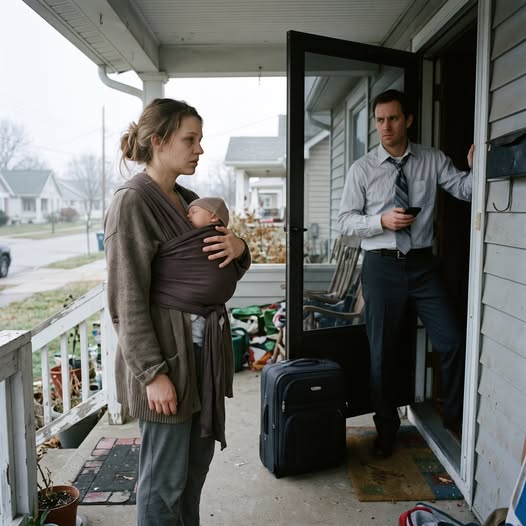
The scent of damp hydrangeas and dried lavender hit me the moment I pulled into the curved driveway of the house on Sycamore Ridge.
It had only been four days, but the place looked alien. The blinds in the master bedroom were drawn shut, and two bags of unopened potting soil Linda had brought over the previous weekend were still slumped on the front steps, soaked through with autumn drizzle.
I turned off the SUV's ignition. In the backseat, my son, Leo, gave a soft snuffle against his car seat lining, his eyelashes fluttering as he drifted back into the warm, oblivious fog of early infancy.
Beside me on the passenger seat lay the court-approved eviction order and the certified surrender agreement bearing Mark’s trembling signature. In thirty minutes, a bonded locksmith hired by Evelyn Henderson was scheduled to arrive with four new high-security deadbolts.
I stepped out into the biting October air, walked up the flagstone steps, and checked the front door. The brass handle was locked, as expected.
Then I looked at the mailbox.
Sticking out of the slot was not a stack of flyers or the usual junk mail. It was a single, long manila envelope addressed to *Mrs. Lauren Mercer* in thick, deliberate strokes of purple ink—the exact ink Linda Mercer used to sign her holiday greeting cards.
I slipped it free. Inside was no note of remorse, no frantic plea for forgiveness.
There was a heavy antique brass key, cold to the touch, and a folded piece of yellow legal paper containing a single, typed paragraph:
*You think you won a house, Lauren. But you only took the frame. Look at the sub-basement behind the wine rack before you celebrate your victory. Mark didn't build Meridian Hearth alone. Ask him where the seed capital came from in 2021.*
My fingers tightened around the edge of the paper until the pulp crushed beneath my nails.
*2021.*
That was the year my father died.
The year my family's estate had settled, leaving me an inheritance of two hundred and twenty thousand dollars—money that I had supposedly invested into a mutual trust portfolio managed by an independent financial advisory firm Mark had chosen.
My pulse began a slow, rhythmic drum against my temples.
The white van belonging to the county locksmith pulled up to the curb, its tires crunching against the wet leaves. A burly man in gray coveralls stepped down, carrying a heavy tool chest.
""Mrs. Mercer?"" he called out, wiping rain from his forehead. ""Evelyn Henderson sent me over. She said you needed every cylinder in this house replaced before sundown.""
""Every cylinder,"" I said, my voice steady, hiding the icy knot forming in my stomach. ""Exterior doors, garage keypad, and the side breezeway. But first, can you pop the front deadbolt?""
""Give me two minutes.""
He set his picks to the lock, the mechanical clicks echoing in the quiet suburban street. With a sharp twist, the tumblers gave way, and the heavy oak door swung inward.
The house smelled of burnt toast, sour milk, and Linda’s heavy floral perfume.
I stepped across the threshold, carrying Leo in his infant carrier. In the kitchen, the remnants of that fateful morning were still frozen in time: the cold frying pan with the burnt bacon grease, the half-eaten loaf of white bread, and the two coffee mugs Mark and his mother had abandoned when the sheriff arrived with the emergency injunction.
""I’ll start on the patio doors, ma'am,"" the locksmith said, stepping past the foyer with his drill.
""Take your time,"" I murmured.
I carried Leo down the hall to the finished nursery, setting his carrier on the floor beside the empty crib. Then, slipping the heavy brass key into my pocket, I walked down the carpeted stairs to the finished basement.
The basement had been Mark’s sanctuary—a home theater, a pool table, and a built-in cedar wine cellar along the foundation wall.
I walked straight to the wine racks.
For seven years, I had dusted those bottles without thinking twice. But as I pulled out two dusty cabernets from the bottom row, I saw what the bottles had been concealing: a small, circular keyhole embedded directly into the oak wainscoting.
The brass key slipped into the hole without resistance.
I turned it clockwise. A soft, hydraulic click sounded behind the wall, and a two-foot section of the cedar shelving swung forward on concealed stainless-steel hinges.
Inside the dark recess lay a fireproof steel lockbox, roughly the size of a briefcase.
I pulled it out onto the carpeted floor. The latch was unlocked.
When I lifted the lid, I wasn't looking at account numbers or bank drafts.
I was looking at a stack of cashier's checks drawn against a bank in Wilmington, Delaware, totaling nearly eight hundred thousand dollars. All of them made out to Meridian Hearth LLC.
And resting on top of the checks was a signed promissory note dated three weeks before my wedding day.
The borrower was Mark Mercer.
The lender was not a bank, not an investment fund, and not his mother.
The signature at the bottom belonged to a woman named Claire Sterling—the senior partner at the accounting firm that had handled my late father's estate.
And scrawled in the margins of the note, in Mark's familiar, aggressive slant, was a single handwritten line:
*The inheritance transfer will clear within ninety days of the nuptials. She will never look at the Delaware filings.*
My phone buzzed in my pocket.
The screen lit up with an incoming call from a number I had blocked three days earlier: Mark's personal cell, calling through an unlisted VoIP exchange.
I swiped the green button and raised the phone to my ear.
""Did you find the box, Lauren?"" Mark's voice rasped through the speaker, devoid of smugness, carrying a raw, jagged edge of pure desperation. ""Because if you touch those cashier's checks, you're not just dealing with family court anymore. Claire Sterling is already on a flight from Philadelphia, and she wants her money back.""
---
Related Stories