Chapter 1: The Weight of Glass
The applause rose like a warm, suffocating wave.
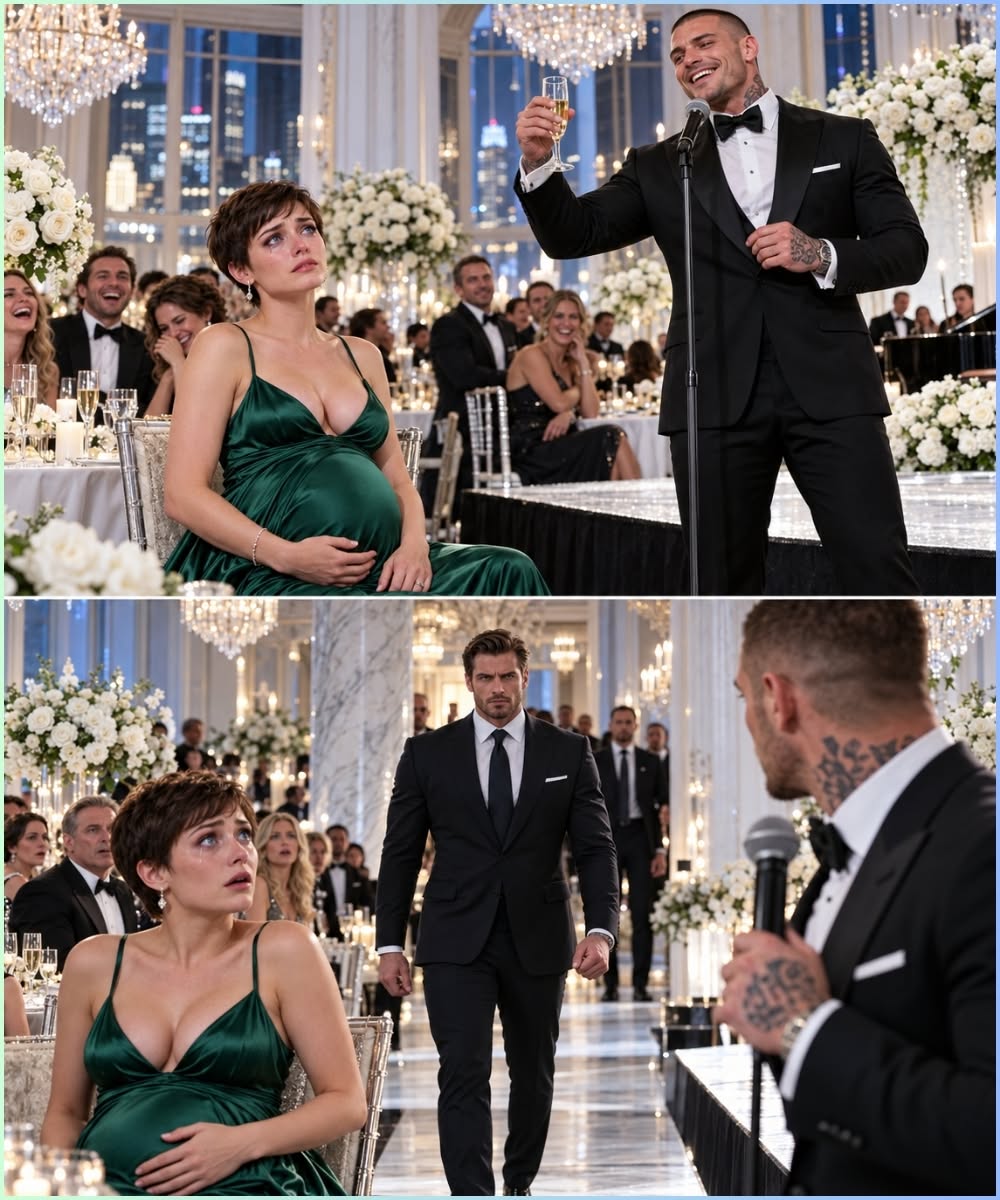
Six hundred pairs of hands beat together beneath the crystal chandeliers, the sound bouncing off gilded moldings and polished marble pillars. At Table One, Grant Caldwell lowered the heavy bronze medal against his chest, bowed his head with practiced humility, and held his smile for the three photographers crouched at the edge of the riser.
He looked every inch the civic savior. Tailored midnight-blue tuxedo. Silver cufflinks catching the glare of the flashbulbs. A posture that radiated quiet, benevolent authority.
“To my wife,” Grant repeated into the microphone, his voice dropping into that rich, intimate register he usually reserved for closing multi-million-dollar land acquisitions. He lifted his champagne flute toward Mara, his eyes crinkling at the corners. “Thank you for giving me a reason to build something that lasts.”
The room erupted again. A prominent alderman’s wife two seats down dabbed at the corner of her eye with a linen napkin. “Oh, Grant,” the woman murmured, turning toward Mara with an expression that was half envy, half patronizing pity. “You are truly the luckiest woman in Chicago. He worships you.”
Mara felt the green silk of her dress pulling tight across her stomach as the baby kicked again, sharp and low. She kept her lips curved into the exact fraction of a smile expected of an adoring consort. She did not raise her glass. Her fingers remained flat against the cool linen of the tablecloth, anchoring herself against the sudden, dizzying tilt of the floor.
*He worships you.*
Ten minutes ago, that same worship had sounded like an invitation to laugh at her body, her tears, her exhaustion, and the life she had surrendered so Grant’s public profile could shine without competition.
Grant stepped off the stage to an orchestra fanfare, moving through a gauntlet of outstretched hands, backslaps, and murmured congratulations. When he finally reached Table One, he didn't sit down. He leaned over Mara’s shoulder, placing one heavy, possessive hand on the nape of her neck. His thumb stroked the sensitive skin behind her ear—a gesture that looked profoundly affectionate from across the room, but felt to Mara like the grip of an escort officer.
“You didn’t stand,” Grant whispered against her hair, his breath carrying the faint, sweet burn of vintage champagne.
Mara kept her gaze fixed on the floral centerpiece of white gardenias. “My ankles are swollen, Grant. The doctor said—”
“I know what the doctor said,” he murmured, the velvet warmth disappearing from his tone, replaced by the flat steel she had come to dread over the last six months. “A standing ovation requires everyone at the family table, Mara. The Tribune photographer caught you sitting. We’ll talk about it in the car.”
He squeezed the back of her neck once, firmly enough to leave a red mark beneath her updo, and then released her as Julian Vance, his managing partner at Caldwell Urban Partners, approached with two city commissioners in tow.
“Grant! Man of the hour!” Julian boomed, wrapping Grant in a half-embrace. “The North Harbor project is all anyone’s talking about tonight. The zoning board is practically eating out of your hand.”
Grant laughed, effortlessly sliding back into his public skin. “It’s about community, Julian. That’s what tonight is about.”
Mara watched the circle of men close around her husband, their broad shoulders forming an impenetrable wall of expensive wool and confident laughter. Within seconds, she was erased. She was just the quiet, swollen ornament resting in the shadow of his success.
Her pulse thudded against her ribs. She looked across the vast expanse of the ballroom, past the towering ice sculptures and the crowded banquet tables, toward the darkened periphery near the service doors.
The solitary figure by the marble pillar was gone.
A cold prickle of adrenaline washed through her veins. Nathan had been there. She hadn't imagined the sharp, predatory stillness of his silhouette or the familiar way his left hand curled into a tight, deliberate fist. For eleven years, her brother had refused to set foot in rooms like this. He despised the performative aristocracy of Chicago’s philanthropic circuit; he called it an auction house where vanity bought forgiveness.
If Nathan had broken his rule, he hadn't done it to drink watered-down prosecco.
Mara pushed her chair back, the wooden legs groaning faintly against the carpet. Grant didn't turn around. His arm was draped over the shoulder of a city planner, his head tilted back in another round of boisterous laughter.
“Excuse me,” Mara whispered to no one in particular, gathering her clutch and the heavy drape of her skirt.
She walked slowly, conscious of the burning ache in her lower back and the eyes tracking her progress toward the exit. She knew what they were thinking: *Poor thing, she’s so tired. Pregnancy really takes a toll on some women.* She let them think it. Invisibility had been her cage for three years; tonight, it was her cover.
She pushed through the heavy acoustic doors into the north corridor. The roar of the gala died instantly, swallowed by thick damask wallpaper and quiet carpeting. Down the hall, past the private dining suites and the closed administrative offices, a solitary sliver of light spilled from the half-open door of the Halston’s historic library.
Mara walked toward it, her heart thumping against her sternum.
She pushed the door open.
Nathan stood by the floor-to-ceiling mahogany bookshelves, his overcoat folded neatly over the arm of a leather wingback chair. He hadn't changed into evening wear; he wore a charcoal turtleneck, a tailored black blazer, and no watch. His face, sharp-boned and pale under the amber sconces, carried the identical dark, slate-gray eyes that Mara saw every morning in her bathroom mirror.
When he turned to look at her, the cold calculation in his gaze dissolved into something raw, fierce, and protective.
“He called you a delivery service with a mortgage,” Nathan said, his voice quiet, deep, and devoid of the easy pleasantries the men in the ballroom traded like currency.
Mara leaned against the frame of the mahogany door, the exhaustion she had been fighting all evening threatening to buckle her knees. “Nathan. What are you doing here?”
“I came to see what you gave up the university archive for,” Nathan said. He didn't move toward her, respecting the distance she had kept between them ever since Grant had subtly, systematically convinced her that the Whitmore family’s wealth was toxic and controlling. “And I came to see if you knew what he’s doing with your name.”
Mara frowned, her hand moving instinctively to cradle the curve of her belly. “What are you talking about? Grant doesn't touch my work. I haven't taken a research grant in over a year.”
Nathan reached inside the breast pocket of his blazer and pulled out a single sheet of heavy cream bond paper, folded into thirds. He didn't hand it to her immediately; he held it between his fingers, his eyes searching her face with an intensity that made the room feel suddenly ten degrees colder.
“Grant submitted a mezzanine financing proposal to Apex Meridian Capital forty-eight hours ago,” Nathan said evenly. “Twenty-two million dollars in private debt to cover an escrow shortfall on the North Harbor development.”
“Apex Meridian?” Mara shook her head, confusion clouding her mind. “Grant’s primary lender is Great Lakes National. He told me the financing was locked six months ago.”
“Great Lakes pulled out three weeks ago when the environmental assessment came back dirty,” Nathan said. “Apex Meridian is a private equity fund. It’s a specialty vehicle managed under the umbrella of Whitmore Holdings. Grant doesn't know that. He thinks it’s an offshore syndicate based in Delaware.”
Nathan stepped forward, extending the folded paper.
“He offered security to close the gap,” Nathan continued, his voice dropping into a register of terrifying calm. “A personal guarantee backed by real property.”
Mara’s fingers trembled as she took the page and unfolded it under the warm light of the library lamp.
It was an irrevocable deed of trust and assignment of assets. Across the top ran the corporate header of Caldwell Urban Partners. Below it, listed in clean, cold legal typeface, were the collateral schedules: the brownstone on Webster Avenue, the private equity shares she had inherited from their grandfather, and the entirety of the Whitmore Family Historical Trust—including her mother’s seventeenth-century cartography collection.
And at the bottom of the page, above the line marked *Grant Caldwell, Managing Partner*, was a second line: *Mara Whitmore Caldwell, Joint Guarantor*.
Across the line sat Mara’s signature.
The loop of the *M*, the sharp slant of the *W*, the delicate cross of the *t*—it was an exquisite, seamless rendering of her hand.
Mara stared at the ink. Her breath hitched in her throat, cold and thin.
“I never signed this,” she whispered, her voice barely a breath. “Nathan, I swear to God... I’ve never seen this document in my life.”
Nathan stepped into her space, his hand resting gently against her shoulder for the first time in three years.
“I know you didn't,” Nathan said softly. “Because the notary stamp at the bottom belongs to a junior paralegal at Grant’s firm. And the date on that signature is October twelfth.”
Mara’s head snapped up, her eyes wide with sudden horror.
October twelfth was the Tuesday she had spent thirty-six hours in the high-risk obstetrics unit at Northwestern Memorial, drifting in and out of consciousness on an intravenous magnesium drip while Grant sat beside her bed, softly stroking her hair and telling her to rest.
---
Related Stories