Chapter 3: The Bloodline Clause
The rain was coming down harder now, drumming a hollow, relentless rhythm against the canvas awning of the small coffee shop across the street from the federal courthouse.
I sat at a corner table with a steaming mug of black coffee and my laptop open, the blue glow of the encrypted defense portal reflecting in the glass pane beside me.
On the screen was the corporate registry for *Aegis Transport International*, a maritime logistics consortium registered in the Cayman Islands with corporate offices in London and Dubai.
Sitting on the master incorporation schedule, listed as the seventy percent beneficial owner, was the name:
*Evelyn Carter-Vance.*
My older sister.
The breath caught in my throat, a sharp, cold ache settling behind my breastbone that had nothing to do with Preston or Arthur Hale.
Evelyn.
Ten years ago, when our father died of complications from exposure in the Gulf War, Evelyn had walked away from our family home in Fayetteville without looking back. She was twenty-four, sharp-tongued, fiercely ambitious, and convinced that our father’s thirty years of military service had been an exercise in decorated poverty.
*""You're just like him, Amelia,""* she had told me on the porch of the funeral home, her eyes dry and unyielding behind designer sunglasses. *""You want medals and flag-draped coffins. I want equity. And equity doesn't give a damn about honor.""*
She had married a London commodities broker six months later, moved to Europe, and vanished from my life. For a decade, the only news I received of Evelyn was through society pages and corporate announcements in the *Financial Times*—a succession of multi-million-dollar fund launches, private aviation acquisitions, and high-end real estate ventures.
And now, her name sat at the center of the trap Arthur Hale had laid for me.
My phone rang.
The caller ID was unlisted, but the cryptographic handshake protocol on my screen confirmed it was routed through the Defense Information Systems Agency.
I accepted the call. ""Captain Carter.""
""Amelia,"" Colonel Reed’s voice came through the earpiece, crisp and low. ""Did you review the Cayman schedules?""
""I'm looking at them now, Colonel,"" I said, keeping my voice level despite the tightness in my chest. ""How long has Aegis been positioned behind Hale Logistics?""
""Fourteen months,"" Reed replied, the rustle of classified briefing papers audible in the background. ""Arthur Hale took out an eight-million-dollar private mezzanine loan from Aegis in September of last year to finance the new cold-storage terminal outside Greensboro. When the construction went forty percent over budget, Aegis exercised an accelerated debt-conversion clause.""
I scrolled down through the PDF of the financing contract on my screen.
There it was. Clause 14-B: *Default Conversion Rights.*
If Hale Logistics failed to meet its third-quarter debt-service coverage ratio, Aegis had the contractual right to seize seventy percent of the operating stock and convert the company's federal munitions routing clearances into a commercial commercial-use charter.
""Arthur didn't transfer that money to Zurich to spite me,"" I realized, the cold, interlocking pieces of the puzzle snapping into terrifying alignment. ""Arthur transferred that twelve point four million dollars to Zurich to pay off the mezzanine loan before Aegis could foreclose on the fleet.""
""Exactly,"" Reed said. ""Arthur was trying to buy back his own company. But under federal procurement regulations, a company operating under a military joint-venture exemption cannot use federal subsidy reserves to service private mezzanine debt without explicit authorization from the contracting officer.""
""Which is why they needed my signature on the divorce settlement,"" I whispered.
""They didn't just need your signature on a divorce settlement, Amelia,"" Reed said, his voice dropping an octave into grave, operational seriousness. ""The settlement agreement Martin Voss tried to slip past Judge Morrison contained an unconditional liability waiver. Paragraph twenty-eight. If you had signed that paper, you would have personally certified that all federal subsidies disbursed to Hale Logistics over the past seven years were utilized exclusively for authorized operational expenditures.""
A cold shudder ran straight down my spine.
If I had signed that document at my breakfast table three weeks ago...
If I had been the broken, submissive housewife they believed I was, weeping over cold eggs and signing whatever papers Preston pushed across the counter...
Arthur would have moved the money to Zurich to pay Evelyn’s firm.
And when the federal auditors discovered the twelve-million-dollar hole in the military logistics account six months from now, the only signature on the certification would have been mine.
Arthur and Preston would have walked away with a clean, privately owned freight enterprise.
And Captain Amelia Carter would have been indicted by a federal grand jury for felony procurement fraud, facing twenty years in a military penitentiary at Fort Leavenworth.
""It was an execution,"" I said softly, staring at the rain streaming down the glass.
""It was a liquidation of your credentials, Amelia,"" Reed agreed. ""Arthur Hale used your clean military record to build his company, and then tried to drop the structural collapse on your head when his private debts came due.""
He paused, a faint, dry chuckle coming through the line.
""He just forgot that you were the best contract prosecutor the JAG corps produced in a decade.""
""Where is Evelyn now, Colonel?"" I asked.
""She landed at Charlotte-Douglas International forty minutes ago on a private Gulfstream out of Teterboro,"" Reed said. ""She’s currently registered at the Ritz-Carlton downtown. And Amelia?""
""Yes, sir?""
""Evelyn’s legal counsel just filed an emergency motion to intervene in your divorce proceeding before Judge Morrison.""
I closed my laptop with a sharp, decisive *click*.
""Thank you, Colonel,"" I said. ""Keep the federal stay active on the Zurich accounts.""
""Consider them frozen in carbonite, Captain. Go finish it.""
I hung up, finished my coffee, and stood up from the table.
I walked out into the rain, crossing the intersection back toward the courthouse rotunda.
The morning’s quiet confidence was gone, replaced by something much older and infinitely harder—the fierce, unyielding resolve of a soldier who had spent her entire adult life defending the line between duty and corruption.
As I pushed through the revolving doors into the courthouse lobby, the elevator doors at the far end of the marble hall opened.
Stepping out into the light, surrounded by two British corporate attorneys in bespoke navy suits, was Evelyn.
She looked thirty-six, but her posture had that timeless, aristocratic stillness of generational wealth. She wore a tailored charcoal wool coat over an ivory silk blouse, her dark hair swept back into an immaculate chignon, her face as sharp and striking as the day she had walked away from our father’s casket.
She saw me immediately.
She didn't stop. She didn't hesitate.
She walked across the marble floor with long, confident strides, her heels clicking crisply against the granite until she stopped three feet from where I stood.
""Hello, little sister,"" Evelyn said, her voice smooth, cultured, and devoid of warmth. ""I see you're still playing with gavels.""
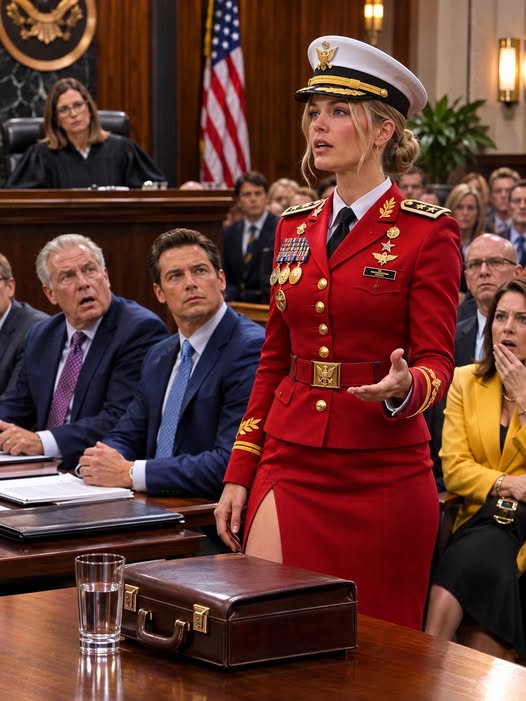
I held her gaze, my chin lifted, my hands resting loosely on the handle of my briefcase.
""Hello, Evelyn,"" I replied, my voice steady as a plumb line. ""I see you're still buying stolen goods.""
---
Related Stories