Chapter 4: The Open Mic
The elevator ride down to the lobby took thirty-two seconds.
Nobody spoke. The mechanical hum of the cables vibrated through our shoes. Ryan stared straight ahead at the brass trim above the doors, his breathing shallow, his jaw set like concrete. When the indicator hit 'G', he reached out, caught the door sensor with his palm, and turned to look at me.
""Are you going back in there?"" he asked quietly.
""I have to settle the master ledger, Ryan,"" I replied. ""I don't leave unpaid debts behind me.""
""Do you want me beside you?""
I looked at his pale, exhausted face, at the stethoscope indentation still faintly visible on his collar from the eighty-hour rotation he had finished thirty-six hours ago just to make this flight.
""No,"" I said softly. ""You’ve bled enough for this family today. Go to the airport, Ryan. Go to Chicago. Don't let them keep another minute of your life.""
A faint, cracked shadow of a smile touched his lips. He nodded once, reached into his jacket pocket, pulled out his own gold wedding band—the one he had bought three weeks ago to present to Bridget during their planned Christmas engagement—and dropped it into the lobby trash receptacle beside the elevator bank with a dull, hollow *clink*.
He walked through the revolving glass doors into the humid Austin dusk without looking back once.
""That man deserves a medal,"" Carmen murmured, watching his silhouette vanish past the valet stand.
""He deserves peace,"" I said, turning toward the double mahogany doors of the grand ballroom. ""Let's finish this.""
From behind the closed doors, the muffled sound of a brass horn section cut through the lobby. The band was playing Stevie Wonder's *Signed, Sealed, Delivered*—a bitter, unintended irony that made the bile rise in my throat.
Allison, the venue coordinator, was standing by the entrance holding her leather clipboard, her face tense as she spoke into an earpiece. When she saw me approaching in my gray silk dress, her eyes widened.
""Ms. Campbell,"" Allison breathed, stepping toward me. ""The guests are... well, they're drinking heavily. Your father told the staff to open the nineteen-eighty-two reserves. Should I cut off the service?""
""No,"" I said, checking my watch. It was 5:58 p.m. ""Keep the bars open until ten. Let everyone have their fill. But I need the wireless house microphone brought to the bandstand.""
Allison’s lips parted. A flicker of professional panic crossed her face, replaced instantly by the cold, fierce solidarity of a woman who had seen too many brides break under the heel of narcissistic men.
""The microphone is already live on Channel Four, Ms. Campbell,"" Allison said, her voice dropping into a firm, supportive whisper. ""The bandleader knows to cut the music the second you step onto the parquet.""
""Thank you, Allison.""
I pushed through the heavy double doors.
The ballroom was an explosion of gold light, crystal reflections, and the loud, nervous chatter of one hundred and forty people trying desperately to ignore the elephant standing in the center of the room.
At Table One, directly beneath the central chandelier, sat my mother, Patricia, and Fletcher’s father, Donald Vance. Patricia was holding a linen napkin against her lips, whispering feverishly to my mother, Margaret, whose face was pale and drawn tight like dried parchment. My father, Arthur, stood near the perimeter bar with two of his old law partners, his hands in his pockets, his posture unyielding as an oak tree.
The moment my gray silk skirt caught the amber spotlights, the room began to quiet.
It started at the back tables—my college friends, my consulting partners, the junior analysts from my firm. Then the silence rippled forward like a shockwave, passing Table Six, Table Four, until it hit the family circle.
The bandleader cut the horns mid-measure. The drummer dragged his brushes across the snare with a dying hiss.
The ballroom went dead still.
I walked up the three carpeted steps to the bandstand. The bandleader, a gentleman named Marcus who had played Austin weddings for thirty years, handed me the heavy silver wireless mic with a solemn, respectful nod.
I adjusted the stand.
I looked out across the sea of white tablecloths, the towering floral centerpieces of cream peonies, the untouched three-tier almond cake sitting beside the dance floor like a monuments to a failed treaty.
""Good evening, everyone,"" I said.
My voice filled the cavernous room, clear, resonant, and entirely free of tremors.
My mother leaned forward at Table One, her hands clutching her pearl necklace. ""Ivy, darling..."" she whispered, loud enough to carry across the front row.
""I want to thank you all for staying,"" I continued, looking directly past my mother to Patricia and Donald Vance. ""Weddings are expensive theater. They require deposits, travel schedules, hotel blocks, and the suspension of disbelief. And tonight, the performance concluded early.""
A low murmur rustled through Table Five.
""Forty-five minutes ago,"" I said, ""Fletcher Vance informed me that a car key in a storm drain was worth more than his presence at this altar. But as many of you who work in business know, the headline rarely tells the full story of the balance sheet.""
I held up the manila folder Ryan had handed me in the corridor.
""This afternoon, we discovered that Fletcher’s absence wasn't an isolated emergency. It was the culmination of a six-month business and domestic enterprise conducted between my fiancé... and my younger sister, Bridget.""
A woman at Table Three gasped—a sharp, violent intake of air that sounded like tearing silk.
Patricia Vance stood up so fast her champagne glass overturned, spilling amber liquid across the white linen. ""Ivy! That is an outrageous, slanderous lie! How dare you speak about my son—""
""Sit down, Patricia,"" my father’s voice boomed from the back of the room.
Arthur Campbell walked slowly down the center aisle, his eyes cold as flint, his hands never leaving his pockets. He didn't look at Fletcher’s mother. He stopped at the edge of Table One, looked down at his wife, and then looked up at me on the stage.
""Tell it, Ivy,"" my father said softly.
I looked at the guests. I saw my colleagues. I saw Fletcher’s cousins. I saw the people who had spent four years telling me how lucky I was to have found such a devoted, caring man.
""The suite in Fredericksburg was billed to my firm's corporate card,"" I said into the microphone, my words dropping like iron weights into the frozen room. ""The texts are timestamped. The key was never lost; the window was open, and the phone was on the seat. Fletcher wasn't rescuing a damsel. He was hiding an affair.""
I set the microphone back onto the chrome stand.
""The catering is paid through ten o'clock. The bar is open. Please celebrate the fact that tonight, two people were saved from a lifetime of very expensive mistakes.""
I stepped off the bandstand.
As my heels hit the parquet floor, the heavy double doors at the back of the ballroom burst open.
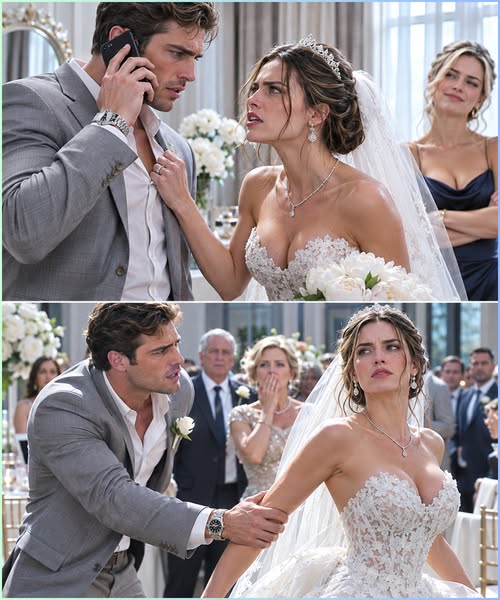
Fletcher stumbled into the light, his tuxedo jacket gone, his shirt soaked in red wine, his face bruised from Carmen's palm, shouting incoherently: ""Ivy! Don't listen to her! She’s vindictive! She planned this!""
Behind him, two Austin Police Department officers stepped through the threshold, followed closely by Celia Park holding a blue legal folder.
The lead officer scanned the room, his hand resting casually on his duty belt, before his eyes locked onto Fletcher.
""Fletcher Vance?"" the officer asked, his voice carrying over the stunned silence of one hundred and forty people.
Fletcher froze, blinking against the chandeliers. ""What? Yes! What is this?!""
""We have a warrant for your arrest, sir,"" the officer said, stepping forward with a pair of stainless-steel handcuffs. ""Grand larceny and commercial identity fraud. Step against the wall.""
---
Related Stories