Chapter 3: The War Room at the Pentagon
At 0630 on Monday morning, the corridors of the Pentagon’s E-Ring were already humming with purposeful energy.
The polished linoleum floors reflected the fluorescent glare overhead as senior officers, defense analysts, and joint chiefs staff moved briskly between briefing rooms with classified red-tabbed folders tucked beneath their arms.
I exited the executive elevator on the second floor, dressed in my pristine Army Service Uniform. The dark green fabric was crisp, adorned with three silver stars pinned squarely on each shoulder board. Across my left chest lay six rows of ribbons—the Defense Distinguished Service Medal, the Silver Star from my days commanding a logistics battalion under heavy fire in Fallujah, the Legion of Merit, and the Master Parachutist badge.
Walking half a step behind me was Major Marcus Cole, my senior aide-de-camp, carrying my briefing portfolio and a secure tablet.
""General Hayes,"" a two-star Air Force major general greeted me as we passed the corridor junction, coming to a sharp halt and rendering a crisp salute.
""Good morning, General Adams,"" I returned the salute cleanly without breaking stride. ""How's the northern radar array looking?""
""Fully operational, ma'am. See you in the Tank.""
We turned down the central corridor leading to Conference Room 2E924—the primary joint operations review facility.
""Major Cole,"" I said, keeping my pace steady. ""Has Fleet Readiness Command arrived?""
""Yes, General,"" Cole replied, checking his digital manifest. ""Vice Admiral Vance checked in fifteen minutes ago. Captain Whitmore and his staff arrived at zero-six-fifteen. They've already loaded their slides for the Chesapeake Defense Initiative.""
""Any flags on the naval liaison's background package?""
""Just the standard efficiency reports, ma'am,"" Cole noted, his voice lowering slightly as we approached the outer security checkpoint. ""Captain Whitmore’s record is solid on surface warfare operations, but his command climate surveys over the last three years are contentious. Several junior officers filed informal grievances regarding retaliatory behavior and toxic leadership during his tenure at Norfolk. Fleet Command smoothed them over to protect his board visibility.""
""Of course they did,"" I murmured.
We reached the secure cipher door. The armed guard snapped to attention, checked my biometric badge, and held the heavy soundproof door open.
Inside, the room was laid out like an amphitheater of military authority. A sweeping mahogany horse-shoe table dominated the center, surrounded by twelve executive leather chairs designated for the joint flag officers. Behind them sat rows of secondary seating for staff officers, technical advisors, and presenting liaisons.
At the head of the table sat Vice Admiral Thomas Vance, looking sharp in his Navy service whites, sipping black coffee while reviewing a printed dossier.
Sitting three seats down from the center, adjusting the microphone at his presentation terminal, was Captain Richard Whitmore.
He looked every inch the self-assured senior officer. His white uniform was impeccably tailored, his gold captain's eagles gleaming on his collar, his ribbons arranged in flawless symmetry. He was leaning toward a junior naval lieutenant, laughing softly as he tapped the podium with a gold pen, clearly relishing the opportunity to present before the joint leadership.
He had not yet looked toward the doorway.
""Gentlemen,"" the room monitor announced in a loud, commanding baritone. ""Attention on deck! Lieutenant General Hayes, Deputy Director for Joint Force Development.""
The room went completely silent.
Every single officer in the room—admirals, generals, colonels, and staff—snapped to their feet in unison, shoulders pinned, heels locked together, eyes fixed straight ahead.
Richard Whitmore snapped to attention along with the rest of the room. He turned his eyes toward the door, his chin raised, waiting to render his salute to the three-star general who held the authority to approve his defense initiative—and his promotion board.
I stepped through the threshold, my polished low-quarter shoes clicking rhythmically against the floorboards.
Richard’s gaze shifted to my face.
I watched the exact fraction of a second his world fractured down the middle.
The color didn't just drain from his cheeks; it collapsed. His jaw went slack, his eyes widening in sheer, disbelieving horror as his gaze tracked the three silver stars gleaming on each of my shoulders, moved down the six rows of combat ribbons, and finally locked onto my face.
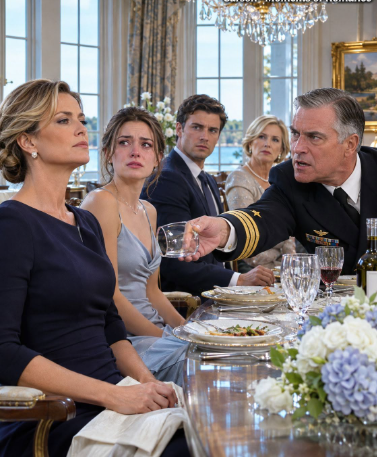
The very same face he had sneered at forty-eight hours ago over a glass of vintage Cabernet.
---
Related Stories