Chapter 5: The Duluth Diesel
The jury deliberated for three hours and twelve minutes.
In military justice, three hours is not a deliberation; it is a formality. It is the time it takes eight officers to sign eight separate ballots and check every statutory box under the Uniform Code of Military Justice.
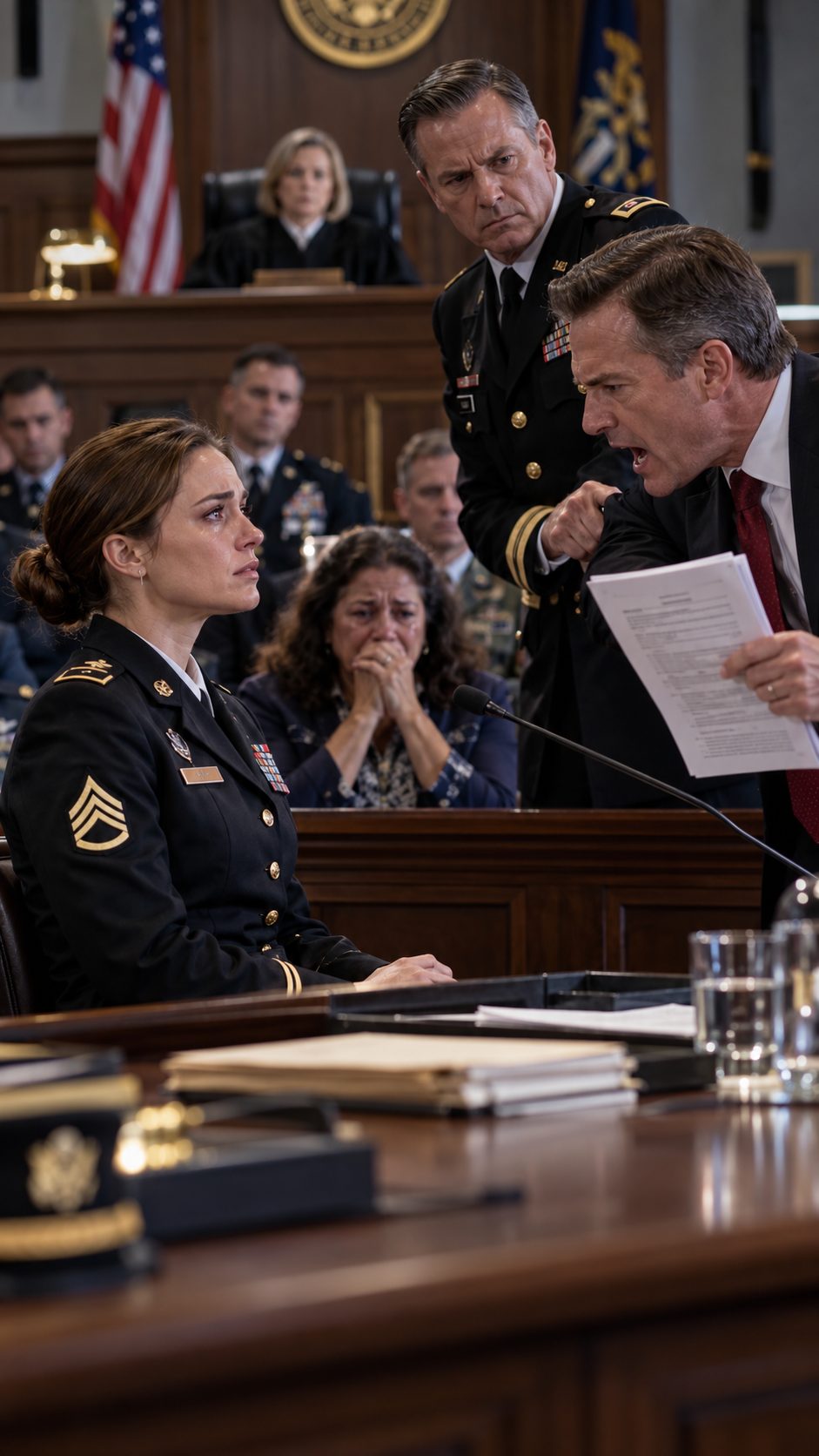
When the panel marched back into the courtroom at 4:15 PM, nobody in the room was sitting down.
The president of the court-martial, a combat-weathered colonel from the 4th Infantry Division with three deployment patches on his right sleeve, stood at attention in the center of the box.
""Lieutenant Colonel Grant Haviland,"" the panel president announced, his voice ringing off the concrete walls. ""On Charge One: Involuntary Manslaughter. Specification: That you did, by culpable negligence, unlawfully kill Specialist Eli Navarro by ordering the operation of an unserviceable tactical vehicle.""
The panel president paused, looking down at the parchment form in his hands.
""The members find you... Guilty.""
A soft, ragged sob broke from Teresa Navarro behind me.
""On Charge Two: Dereliction of Duty resulting in death. Guilty.""
""On Charge Three: Conduct Unbecoming an Officer. Guilty.""
""On Charge Four: Subornation of Perjury and Obstruction of Justice. Guilty.""
Haviland didn't move. He stood at the defense table with his head bowed, his hands clasped behind his back, staring at the floorboards.
Judge Holloway didn't wait for the formal sentencing phase to issue her preliminary administrative orders.
""Lieutenant Colonel Haviland,"" Judge Holloway said, her tone as cold and final as winter granite. ""Pursuant to the findings of this court, you are remanded immediately to the custody of the United States Disciplinary Barracks at Fort Leavenworth, pending formal sentencing tomorrow morning. Bail is denied.""
She looked at the provost marshal standing by the door.
""Remove the prisoner.""
Two military police officers stepped forward.
One of them reached out, took the silver oak leaves from Haviland’s collar, and placed them flat on the defense table.
Then the steel handcuffs clicked shut around his wrists with a sharp, heavy *clink* that echoed through the empty quiet of the room.
Haviland was led out through the side security door, his head down, his boots shuffling on the linoleum.
He never looked back.
---
The sun was sinking behind the front range when I walked out of the legal building for the last time.
The Colorado sky was streaked with dark violet and amber, the snowcaps on the peaks catching the final sliver of daylight.
Down at the bottom of the concrete steps, Teresa Navarro was waiting beside an old gray sedan.
She was alone now. Her sister had gone to fetch their coats from the hotel.
I walked down the steps, my service cap tucked under my left arm.
""Sergeant Hensley,"" she said as I stopped on the gravel.
""Mrs. Navarro.""
She reached into her coat pocket and pulled out an old, worn brass wrench—a 9/16 combination wrench with the chrome peeled away at the box end from years of hard use.
Stenciled along the handle in black permanent marker was a name: *E. NAVARRO.*
""The casualty assistance officer brought his personal effects to the house three weeks after the funeral,"" Teresa said, holding the tool out toward me on her open palms. ""His clothes. His boots. His drawings. And this was in the pocket of his coveralls.""
I looked down at the wrench.
I remembered Eli standing over the secondary air line in Bay Three, his knuckles skinned, wiping that exact wrench on an oily rag before hanging it back on the shadow board.
*“Never borrow a tool without wiping it clean, Sergeant.”*
""I can't take that, Mrs. Navarro,"" I whispered, the tightness in my throat threatening to choke me. ""That belongs to you.""
""No,"" she said gently, pressing the cold steel into my fingers, closing my hand around it. ""Eli would have wanted you to have it. He told me you were the only one who cared whether the machines were right.""
Tears finally broke over my lashes, hot and burning in the freezing mountain wind.
I held the wrench tight against my ribs, feeling the cold weight of the metal through my uniform jacket.
""I'm sorry, Teresa,"" I sobbed, the words I had held inside for three long, silent years finally tearing free. ""I should have stood in front of that truck. I should have laid down in the dirt before I let him drive it out of that gate.""
Teresa reached up, her hands cupping my face, her rough thumbs brushing the tears from my cheeks.
""You told the truth, Willa,"" she whispered. ""When everyone else was lying to save their own skin, you stood up and you told the truth. That's all my boy ever would have asked of you.""
She leaned in and kissed my cheek.
Then she got into the passenger seat of the gray sedan, closed the door, and her sister drove them slowly out toward the main gate, their taillights disappearing into the gathering dark.
I stood on the gravel apron for a long time, listening to the wind whistling through the chain-link fence of the motor pool fifty yards away.
My phone vibrated in my trouser pocket.
I pulled it out, expecting a message from Captain Vega about tomorrow’s sentencing formalities.
Instead, the display showed a priority encrypted email notification from the Department of the Army Human Resources Command in Fort Knox:
*SUBJECT: OFFICIAL ORDERS // ASSIGNMENT DIRECTIVE.*
*FROM: OFFICE OF THE DEPUTY CHIEF OF STAFF, G-4 (LOGISTICS).*
*TO: MASTER SERGEANT (PROMOTABLE) HENSLEY, WILLA.*
I stared at the screen.
*Master Sergeant (Promotable).*
The board had met in secret three weeks ago, following the Inspector General's report.
My rank had not just been restored; the promotion list had been adjusted with three years of back pay and seniority.
I scrolled down to the assignment section:
*PRIMARY DUTY: CHIEF MOTOR TRANSPORT INSPECTOR // TANK-AUTOMOTIVE AND ARMAMENTS COMMAND (TACOM).*
*DUTY STATION: REGIONAL DEPOT FACILITY — DULUTH, MINNESOTA.*
*EFFECTIVE DATE: DECEMBER 01, 2026.*
I lowered the phone.
Duluth.
The cold wind blew off the mountains, but I didn't feel it anymore.
I looked down at the 9/16 wrench resting in my hand, running my thumb over the rough black letters of Eli’s name.
A twenty-two-year-old boy had wanted a shop with his name over the door.
He was never going to build it.
I looked toward the north, where the highway stretched out through the dark toward Wyoming and the flat lakes beyond.
I slipped the wrench into my inside pocket, right next to the red-bordered dispatch, and whispered to the empty air:
""We're going to Duluth, kid.""
Related Stories