Chapter 4: The Secure Transmission
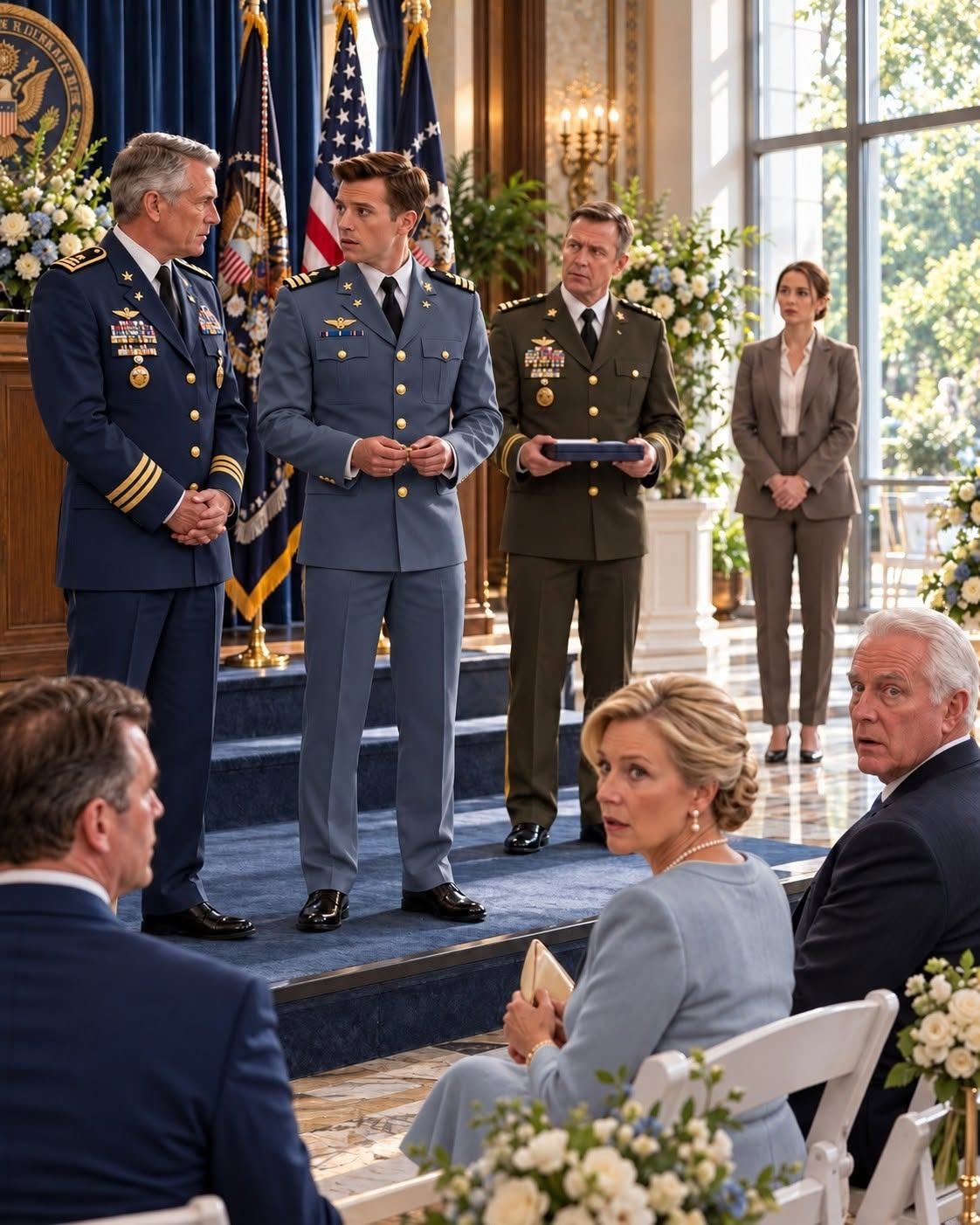
General Vance reappeared beside us, carrying a slim leather folder stamped with a crimson classification banner.
“Ignore the family reunion, Captain Mercer,” Vance said smoothly, casting a sharp, appraising glance at my father and brother before focusing entirely on me. “We have an immediate operational spillover from the Black Sea sector. The satellite feed just updated. The secondary package we thought was compromised? It’s moving.”
Edward Mercer instinctively puffed out his chest, trying to insert himself into the conversation as one retired captain to a three-star general. “General Vance, I am Captain Edward Mercer, United States Navy, retired. I think as her father—”
“With all due respect, Captain Mercer,” Vance interrupted without even turning his head to look at him, his tone flat and utterly dismissive, “your daughter stopped belonging to your household the day she signed her TS/SCI clearance papers eight years ago. Right now, she’s the only person in this zip code cleared to authorize a kinetic intercept on a rogue tanker. So if you don't mind, we have a war to manage.”
The words hung in the air like a physical blow.
*TS/SCI clearance. Kinetic intercept.*
This wasn't insurance claims. This wasn't clerical work. The reality of what I did for a living crashed down around my father with such force that he actually staggered back half a step, catching his hip against the edge of the wooden podium.
I didn't gloat. I didn't feel the satisfying rush of sweet revenge I had sometimes imagined during my loneliest nights at the D.C. office. I just felt tired.
“Show me the feed, General,” I said, stepping past my stunned family members as if they were nothing more than decorative props on a stage.
Vance opened the leather folder, revealing a ruggedized tactical tablet displaying a high-contrast thermal satellite image of a dark coastline. Tiny red and blue vectors blinked across the screen, tracking real-time telemetry from an unmapped stretch of the Mediterranean.
“They’re vectoring toward a civilian shipping lane,” Vance murmured, pointing a finger at a blinking crimson dot. “If they cross the 34th parallel before our strike package reaches them, we lose plausible deniability.”
I stared at the vectors for two seconds. The math was already running in my head—wind shear, current drift, encrypted radio frequencies bouncing off commercial weather satellites.
“They aren't heading for the shipping lane,” I said, tapping the screen with my index finger. “Look at the oscillation pattern on the third vector. They’re looping back toward the old naval installation we cleared out during Operation Meridian.”
Vance frowned, leaning closer. “Why would they go back into a hot zone?”
“Because the primary server room still has an active backup generator tied to the municipal grid,” I explained, my voice falling into the rhythmic, hypnotic cadence of tactical analysis. “They aren't running away. They’re trying to scrub the local hard drives before the base cleanup crew arrives tomorrow morning. If they succeed, we lose the ledger linking the local cartel to half the defense contractors in Washington.”
Silence stretched between us for a moment. Vance looked from the tablet up to my face, a slow, grim smile spreading across his lips.
“You can lock it down remotely?” Vance asked.
“I already wrote the kill-switch script three weeks ago in anticipation of this exact maneuver,” I said, pulling my secure phone from my blazer pocket once more. “I just needed ground confirmation that the primary nodes were offline.”
I tapped my thumb against the screen, verified my biometrics, and entered a twelve-digit cryptographic sequence.
*EXECUTE_KILL_SWITCH://NODE_MAP_MERIDIAN*
On the tablet, the blinking red vectors suddenly froze, flared bright amber, and then winked out of existence one by one as the mainframe fifty feet beneath an abandoned bunker in Europe erased itself down to the bare silicon.
---
Related Stories