Chapter 1: The Weight of the Uniform
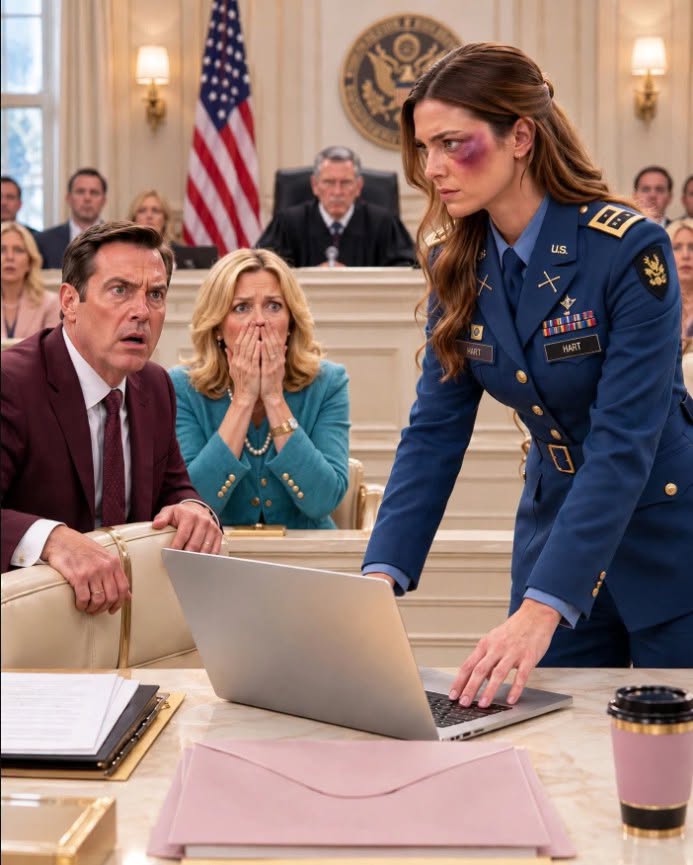
I stood at the defense table, my posture rigid, my boots flat against the floor.
Judge Samuel Greene’s eyes lingered on the ribbons pinned to my dress green jacket—the Bronze Star, the Purple Heart, the Ranger tab—before shifting back to the purple bruise swelling beneath my left eye. A heavy, thoughtful crease formed between the judge’s gray eyebrows.
Walter Hart’s attorney, a slick-haired man named Vance Miller who had handled every shady real estate transfer in Cumberland County for twenty years, stood up with an oily, practiced smile.
“Your Honor, for the record, Vance Miller representing Walter and Sylvia Hart,” he began, his voice booming smoothly through the courtroom. “We are presenting a motion for emergency temporary conservatorship regarding the late Arthur Vale’s estate—specifically, the homestead and surrounding acreage currently deeded to Major Leah Hart.”
Judge Greene didn’t look at Miller. He kept his eyes on the file. “Grounds, Mr. Miller? The property was deeded directly to Major Hart by her grandfather three years before his passing. The title appears unencumbered.”
“Unencumbered legally, perhaps, Your Honor, but not practically,” Miller said, stepping forward with a theatrical sigh of grave concern. “As my clients’ petition outlines, Major Hart has recently returned from active military combat suffering from severe, unmanaged psychological trauma. Post-traumatic stress, episodes of disorientation, unpredictable aggression, and acute emotional instability.”
My jaw tightened. I kept my hands flat on the wooden table, my fingernails pressing into my palms.
“Mr. Miller,” Judge Greene warned softly. “Be careful how you characterize a service member without medical evidence.”
“We have evidence, Your Honor,” Miller said smoothly, turning to gesture toward the gallery. “More importantly, we have a concerned father who only wants to protect his daughter from herself. Walter Hart has witnessed firsthand his daughter’s episodes—including violent outbursts, confusion regarding her surroundings, and a dangerous detachment from reality. Given her combat record, she is simply a danger to the legacy her grandfather built.”
At the defense table, Walter Hart bowed his head slightly, adopting an expression of profound, sorrowful paternal sacrifice. He looked like a martyr carrying the burden of an unstable daughter.
Judge Greene looked down at me. “Major Hart. You are representing yourself?”
“Yes, Your Honor,” I said. My voice was clear, steady, and devoid of the tremor Miller expected.
“Do you contest the petition for conservatorship?”
“ Entirely, Your Honor,” I replied, stepping slightly away from the table. “My father’s petition is not based on my mental health. It is based on land. When my grandfather, Arthur Vale, passed away six months ago, his will left his one-hundred-and-fifty-acre farm entirely to me. My father expected that land to be divided and sold to commercial developers for industrial warehousing. When I refused to sign over the deed, my father attempted to coerce me. When coercion failed, he assaulted me.”
A sharp gasp rippled through the gallery.
Walter Hart shot out of his chair so fast his wooden bench scraped loudly against the floor. “That is a lie! A filthy, delusional lie! Your Honor, look at her! She’s hallucinating! She came to our kitchen six days ago shouting about things that never happened, tripped over a kitchen stool, and struck her face! She is combat-damaged, Judge Greene! She doesn't even know what year it is!”
Judge Greene raised a single hand, and the courtroom instantly fell dead silent. His tired eyes shifted slowly from Walter Hart’s flushed, angry face back to mine.
“Major Hart,” the judge said quietly. “You just accused your father of physical assault in open court. That is a very serious charge. Do you have proof?”
---
Related Stories