Chapter 4: The Hands in the Dirt
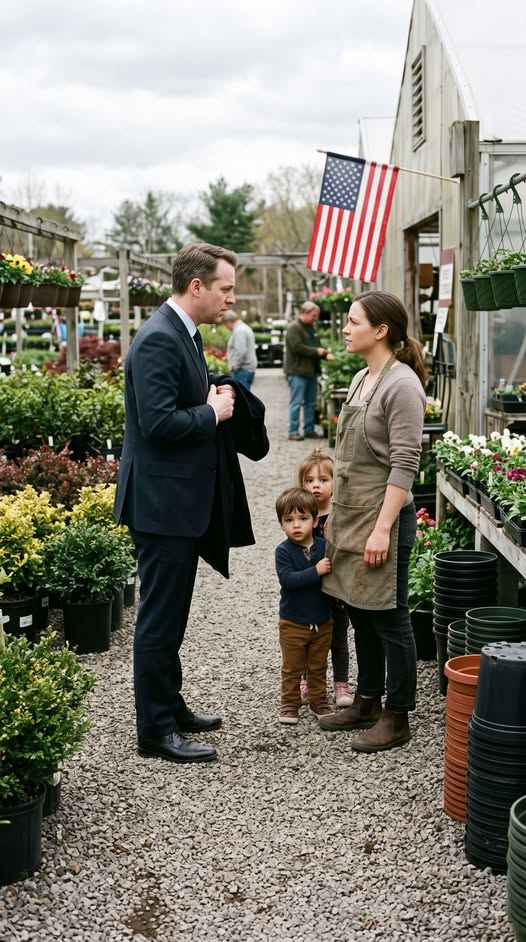
The earth was heavy, clogged with clay and river stones that fought the steel blade of the shovel with every strike.
Within twenty minutes, my palms—soft from years of signing contracts and holding fountain pens—were blistering beneath my work gloves. Sweat stung my eyes, dripping from my forehead into the cold dirt, but I didn't stop. With each trench I cleared, with each root ball I set into the soil and tamped down with the heel of my boot, a strange, primitive rhythm took hold of me.
For seven years, I had believed that creating value meant moving digital numbers across an international wire.
Now, kneeling in the muck behind a drafty greenhouse, feeling the physical ache in my shoulders, I understood what Penelope had tried to show me every Sunday morning we had wasted: *Life does not happen on a balance sheet. It happens in the dirt you are willing to bleed for.*
By 6:45 AM, thirty of the forty hydrangeas were buried safe beneath the frost line, their bases mulched with cedar chips.
The eastern sky had turned to pale gold, cutting through the river mist, illuminating the dew on the grass like a field of scattered diamonds. My breath came in ragged, wheezing gasps, my wool sweater soaked with sweat and rain, my jeans caked in red clay.
""You're planting them too shallow,"" a voice said.
I froze, the spade suspended mid-stroke in the soil.
Standing at the edge of the gravel path, holding a steaming metal thermos and a tin mug, was Penelope.
She wore an oversized woolen barn jacket, her hair loosely braided over one shoulder, her breath curling in soft clouds around her face. She didn't look angry. She looked at the fresh trench, looked at the blister that had burst through my torn glove, and then looked down into my face with an expression of profound, quiet bewilderment.
""The root collars need two inches of clearance, Graham,"" she said softly, her voice carrying no mockery, only an exhaustion that went deeper than bone. ""If you bury them that tight, the spring rains will rot the crowns.""
I didn't stand up. I stayed on my knees in the mud, holding the shovel like an anchor, looking up at the woman whose heart I had shattered for a fantasy of glass and steel.
""I can adjust them,"" I rasped, my throat raw from the cold air.
Penelope walked over, her boots silent on the mulch. She set the tin mug down on an upturned wooden crate, unscrewed the thermos, and poured a stream of dark, steaming coffee into the cup. The scent of chicory and roasted beans filled the space between us.
""Why are you doing this?"" she asked, looking down at me. ""Do you think manual labor is penance? Do you think if you sweat in my garden for three hours, it erases the text message you sent three years ago?""
""No,"" I whispered, dropping the shovel. It fell flat against the dirt with a dull thud. ""I don't think it erases anything. I don't think fifty lifetimes of sweating in this garden could pay for what I did to you.""
""Then why are you here, Graham?""
""Because the frost was coming,"" I said simply, looking at the raw blisters on my palm. ""And because... I didn't know what else to do with my hands. I couldn't sit in that penthouse knowing these flowers were going to die because you didn't have enough help.""
Penelope stared at me. For a second, a flicker of the old Penelope broke through the surface of her eyes—the girl who used to touch my cheek when I worked late, the girl who believed that beneath the armor of the real estate mogul, there was a man capable of grace.
Then, the wooden screen door of the cottage banged open across the yard.
""MAMA!""
A high, joyous shout shattered the morning quiet.
Little Clara came barreling down the porch steps, wearing pink rubber boots that reached her knees and an oversized knit cap pulled down over her ears. Right behind her trotted Leo, holding a half-eaten piece of toast in one hand and that battered yellow plastic spade in the other.
""Slow down, both of you!"" Julian’s voice boomed from the porch as he stepped out with a tool belt slung over his shoulder.
Penelope stiffened. She stepped in front of me instinctively, her body forming a shield between the children and the broken man kneeling in the mud.
""Penelope, please,"" I murmured, rising slowly to my feet, my knees cracking, my hands trembling at my sides. ""Don't hide them. Please.""
Clara skidded to a halt on the gravel path, her wide brown eyes locking onto me. She tilted her head, her nose wrinkling as she examined my mud-streaked face and torn sweater.
""You're the man from yesterday,"" Clara announced, pointing a sticky finger at my boots. ""You have dirt on your nose.""
A choked sound escaped my chest—half a laugh, half a sob. I wiped my face with the back of my filthy sleeve, leaving another smear of clay across my cheek.
""I do,"" I managed, my voice breaking. ""I was helping your mom with the flowers.""
Leo stopped beside his sister. He didn't run. He didn't hide behind Penelope's skirt this time. He took a bite of his toast, chewed it slowly with solemn contemplation, and then looked down at the freshly dug trench.
He walked over to the wooden crate, set his piece of toast down on the edge, picked up one of the remaining unplanted hydrangeas by its burlap collar, and dragged it three feet across the mulch toward the hole I had just dug.
He looked up at me, his hazel eyes locking onto mine with the unquestioning, uncorrupted honesty of a child.
""Put it in the hole,"" Leo commanded, pointing his plastic spade into the trench.
My heart didn't just break; it detonated inside my chest. The world stopped spinning. The boardroom, the holdings, the forty-story towers, the millions of dollars—all of it vanished into the thin morning air, leaving only this three-foot-tall boy, a patch of cold dirt, and a command to put the plant in the hole.
I dropped to my knees again.
My hands, bleeding and caked with mud, reached out and gently took the burlap bundle from his small fingers.
""Together,"" I whispered, my vision swimming with tears I could no longer hold back. ""We'll do it together, Leo.""
Leo nodded once, dead serious, and drove his plastic spade into the soil beside my fingers.
Penelope turned her face away, her hand coming up to press against her trembling mouth, her shoulders shuddering once in the cold morning light.
Julian stepped off the porch, walking slowly down the path, stopping five paces away. He didn't intervene. He leaned against the corner of the greenhouse, his arms crossed over his chest, his weathered face completely unreadable as he watched the billionaire on his knees taking orders from a toddler.
For thirty minutes, nobody spoke.
Leo handed me the roots. I set them in the ground. Clara brought two handfuls of cedar mulch, dropping half of it on my boots, giggling as the wind caught the wood chips.
When the last hydrangea was settled into the earth, Leo dusted his small hands against his overalls, picked up his toast from the crate, and looked at me with an approving nod.
""Good job,"" the boy said.
Then, without another word, he took Clara’s hand and scampered off toward the chicken coop, their laughter echoing like silver chimes across the morning frost.
I stayed on the ground, my head bowed, my breath coming in deep, ragged shuddering waves.
Penelope picked up the tin mug of coffee from the crate and stepped forward. She held it out to me.
""Drink it, Graham,"" she said softly. ""You look like you're about to collapse.""
I took the mug with two hands, the heat searing through my raw skin, grounding me. ""Penelope... I don't know how to fix this. But I'm not leaving. I will buy a tent and sleep in that ditch if I have to. I will dig every trench in this county. Just let me know them.""
Penelope looked down at me, her eyes glistening with unshed tears.
""It's not that simple, Graham,"" she whispered. ""You think the only obstacle between you and these children is my forgiveness. But you brought something dark with you when you came down that road yesterday.""
Before I could ask what she meant, the deep, mechanical rumble of heavy machinery broke the valley's silence.
From the crest of the hill, three commercial flatbed transports and a massive yellow earthmover crested the ridge, grinding their gears as they turned onto the private nursery access road.
Leading the convoy was a sleek black town car.
The car stopped at the front gate, and Arthur Sterling stepped out, holding an official red leather folder and a megaphone, flanked by two uniformed county constables.
---
Related Stories