Chapter 1: All Rise for the Reality
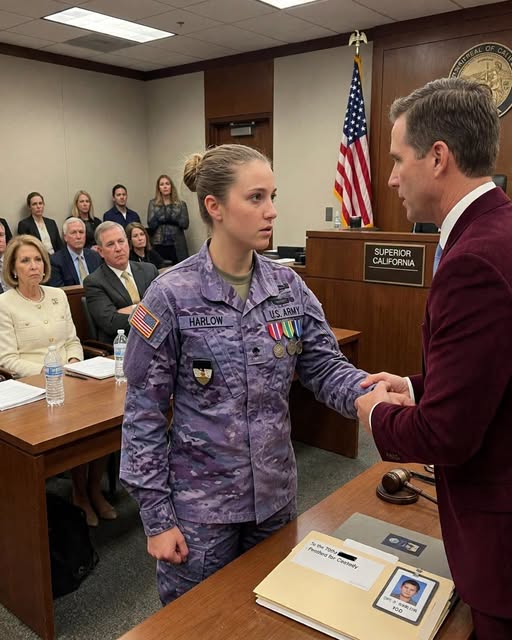
The heavy oak door at the side of the courtroom swung inward with a dry, solemn squeak.
“All rise,” the bailiff barked, his voice bouncing off the high, acoustically engineered ceilings of Courtroom 4B. “Hear ye, hear ye, hear ye. The Superior Court of Mecklenburg County is now in session. Judge Harmon presiding. All manner of persons having business before this court are admonished to draw near and give their attention.”
Everyone stood.
My father, Richard Hale, adjusted his silk tie with manicured fingers, rising smoothly to his full height. My mother, Evelyn, smoothed the cream silk of her skirt, though her eyes remained darting sideways toward Bradley Vance, the high-priced attorney they had retained to dismantle my life.
Vance was still standing a little too close to me. The color had not fully returned to his face. He had retreated half a step, his expensive navy cuffs adjusted automatically out of sheer nervous habit, but his gaze remained locked on my left shoulder—specifically at the small red-and-black insignia clipped near the collar.
It wasn't a standard unit patch.
It was a classified designation marker belonging to Joint Special Operations Command (JSOC). The kind of insignia you only wore if you had spent the last twenty-four months working inside secure bunkers where coordinates were designated by letters that didn't exist on public maps.
I didn't blink as Judge Harmon entered.
He was a man in his sixties with thinning gray hair, rimless glasses, and the weathered, tired look of someone who had spent thirty years watching broken families tear each other apart over bank accounts, real estate, and bruised egos. He settled heavily into his high-backed leather chair, surveyed the room through his lenses, and gestured with a silver pen.
“Be seated,” the judge commanded.
We all sat down.
My parents took their positions at the petitioner's table. Vance joined them immediately, leaning down to whisper something rapid and urgent into my father's ear. Richard Hale’s forehead creaked into a frown. He glanced sideways at me, his eyes full of defensive irritation, as if my refusal to wear a floral dress to a family court hearing was a personal insult to his corporate brand.
I sat alone at the respondent’s table.
No fancy counsel. No briefcase filled with corporate stationary. Just my tactical belt, my dust-stained combat boots, and a single manila folder containing documents that had been printed on secure military terminals before my transport flight touched down at Charlotte Douglas International three hours ago.
“We are here,” Judge Harmon began, picking up the case file and flipping open the cover, “in the matter of Hale versus Hale. Petition for emergency conservatorship and guardianship evaluation, filed by Richard and Evelyn Hale against their daughter, Maya Hale. Mr. Vance, you represent the petitioners?”
Bradley Vance stood up, buttoning his jacket with smooth, practiced grace. His voice regained its courtroom resonance, though his fingers still twitched slightly.
“Yes, Your Honor,” Vance said, stepping forward. “We appear before this court today out of profound parental concern. As the court can see from our initial filings, my clients are respected members of this community. Richard Hale is the CEO of Hale Strategic Holdings. They have attempted, for over a decade, to assist their daughter through a period of severe psychological distress—distress that has manifested in profound detachment from reality, wandering behavior, and a persistent delusion concerning military service.”
My mother dabbed the corner of her eye with her handkerchief. It was a masterpiece of theatrical grief.
“Go on, counselor,” Judge Harmon prompted, his expression flat.
“Thank you, Your Honor,” Vance continued, warming to his theme. “Miss Hale abandoned her familial obligations years ago under the guise of an imaginary military enlistment. She has subjected her parents to years of erratic communications, sudden disappearances, and aggressive refusal to integrate into normal society. Today’s theatrical attire—wearing tactical gear and surplus combat paraphernalia into a court of law—is, frankly, Exhibit A of her unstable mental state. We are requesting an immediate court-ordered psychiatric evaluation and temporary guardianship of her estate and person.”
Vance sat down, looking very pleased with himself.
My father nodded in quiet approval.
Judge Harmon lowered the case file, looked over the rims of his glasses, and shifted his gaze across the room.
“Miss Hale?” the judge asked quietly. “You are representing yourself?”
“Yes, Your Honor,” I said, standing up from my chair.
The movement was deliberate. I didn't slouch. I didn't fidget. I stood at a relaxed parade rest, my boots planted firmly on the worn linoleum floor.
“Do you have any opening statement or response to the petitioner’s claims?” the judge asked.
“I do, Your Honor,” I replied. “And I have evidence that will clarify exactly why my parents filed this petition today. It has very little to do with my mental health. And everything to do with a hundred-million-dollar trust fund they are currently trying to liquidate without my consent.”
The courtroom erupted into instant, whispering chaos.
Related Stories