Chapter 4: The Living Ghost
The silence in the auditorium was so absolute you could hear the faint hum of the electrical transformers in the ceiling.
Every eye in the room snapped from General Vance to me.
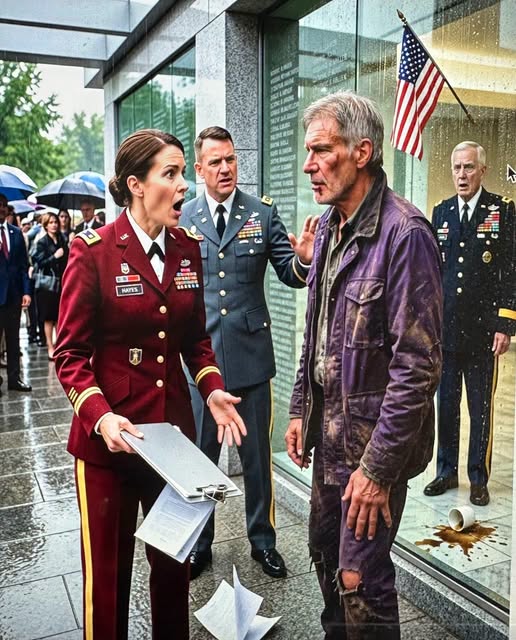
I stood there under the blinding theater lights, my coat soaked and dripping a dark puddle onto the pristine carpet, my face bruised and smeared with mud from the plaza outside. I must have looked like a wraith dragged straight out of a nightmare.
Marcus gestured with his hand, urging me forward toward the microphone.
I hesitated. For fifty years, I had hidden in the margins of society. I lived in basement apartments where nobody asked questions, worked cash-in-hand construction jobs where a Social Security number wasn't required, and watched Veterans Day parades from three blocks away, half-convinced that if anyone recognized my face, the universe would correct a cosmic error and strike me down.
I didn't belong in a room like this. I belonged in the dirt.
""John,"" Marcus said softly, his voice carrying a command I couldn't ignore. ""Tell them.""
I gripped the sides of the podium. The wood was smooth, expensive, and polished to a mirror shine. My knuckles were bruised, gray, and scarred.
""I... I wasn't supposed to survive,"" I began, my voice raspy and thin at first, echoing weakly against the microphone before finding its footing.
I cleared my throat, looking out at the rows of faces. I saw shock. I saw disbelief. And in the second row, I saw an elderly woman—her hair white as snow, holding a folded American flag in her lap—staring at me with eyes wide and unblinking, as if she were looking straight through a portal into another world.
""In November 1968, we were out of rations, out of clean water, and out of luck,"" I said, my gaze drifting back to the black granite wall behind the stage. ""We had wounded men we couldn't carry and an enemy battalion closing in from three sides. Our radioman, Tommy Miller, took a round through the chest right before the final push. We split up to draw fire away from the extraction zone. I told the boys to run south toward the river. I stayed behind with a grease gun and three magazines.""
A murmur rippled through the crowd. A man in the fifth row stood up halfway, his mouth opening in astonishment.
""They told me I died,"" I whispered, a bitter smile touching my swollen lip. ""And for a long time, part of me wished I had. When I finally crawled out of a POW transit camp in Cambodia three years later, broken, half-starved, and speaking barely a word of English, the war was over. The country had moved on. The dossiers were closed. The casualties had already been processed, buried, and forgotten.""
I reached into the inside pocket of my heavy, sodden coat.
The plastic grocery bag rustled loudly over the sound system.
I pulled out the yellowed, water-stained newspaper clipping and laid it flat on the wooden podium.
""I kept this clipping in my pocket through every winter I slept under a bridge,"" I said, my voice steadying, growing stronger with every word. ""Not because I wanted a medal. Not because I wanted back pay or a monument. I kept it because every time I looked in the mirror and wondered if I was real or just a ghost haunting a life I had no business keeping... I needed to know that at least on paper, I had brothers who remembered my name.""
In the front row, the elderly woman with the flag stood up.
Her hands trembled violently. She dropped the flag onto her seat, pushed past her family members, and walked straight down the aisle toward the stage, her eyes locked entirely on my face.
---
Related Stories