Chapter 1: Two Envelopes
The marble corridor became so silent that I could hear the faint hum of the scanner in the hostess's hand.
My husband stood next to me wearing his Army dress uniform, every medal arranged with the same precision he always used when preparing for photographs. Just ten minutes earlier, while we were still in the car, he'd adjusted his collar in the mirror and cautioned me against making unnecessary conversation.
""There will be generals here, Sloane.""
""I'm aware.""
""Cabinet secretaries, too.""
""I know.""
As we approached the East Wing security checkpoint, he bent closer to my ear. ""Just remember to smile when you're expected to.""
That was what settled painfully in my chest. Not the instruction itself. Not even his hushed tone. It was his unquestioned belief that I was there simply to look presentable beside him.
My husband is Colonel Mitchell Ashcroft. I'm Colonel Sloane Merrick. Equal rank. Same Army. Twenty-four years of service apiece. Yet throughout our three years of marriage, Mitchell had treated my work in Army logistics as though it were little more than an elaborate clerical assignment.
At backyard barbecues, he'd introduce me as ""the queen of spreadsheets."" Whenever we visited his mother's house, he'd joke that the Army had finally decided I was qualified to handle the oversized paper clips. His mother would laugh, gently touch his arm, and remark how relieved she was that at least one of us had a career ordinary people could understand.
I allowed them to laugh. Explaining what my office truly handled wasn't an option. I'd signed documents that made that perfectly clear. I'd spent countless hours in rooms where phones were prohibited, coordinating evacuation routes and arranging the movement of medical supplies, fuel, aircraft, and personnel through regions most of tonight's guests wouldn't even recognize on a map.
So I remained silent. And Mitchell interpreted that silence as proof that I had nothing important to contribute.
Then our invitations arrived. His came first, printed on thick, cream-colored stationery with his name displayed prominently. He held it up in our kitchen as proudly as if he'd received another medal, then called his mother before the envelope had even finished falling onto the counter.
""Mom, we're going to the White House!""
But the truth was, he never really meant ""we."" He meant himself.
My invitation arrived two days afterward, tucked inside an ordinary government envelope. It contained different directions. A separate designated arrival time. And a single sentence from the White House protocol office that made my hands stop moving as I stood at the kitchen counter.
I slipped it into my desk drawer and never mentioned it.
On the evening of the ceremony, Mitchell paid almost no attention to me until we approached the security station. He offered his invitation with a small, confident flourish. The hostess scanned it and gave him a pleasant smile.
""Welcome, Colonel Ashcroft.""
He responded with a satisfied nod, as though the entire White House had just validated everything he'd always believed about his own importance.
Then the hostess looked toward me. I opened my handbag and passed her my envelope.
Mitchell's smile faltered. ""What's that?""
I said nothing. Instead, I watched her move the scanner across the small square code. Beep. She studied the information on her screen, then scanned the code a second time, more carefully.
The change came immediately. First in her expression. Then in her posture. She reached toward the radio fastened to her jacket.
""Protocol, this is checkpoint one,"" she said softly. ""She's here.""
On the opposite side of the hallway, a four-star admiral abruptly stopped speaking halfway through a sentence. He excused himself from the two generals standing with him and headed directly in our direction.
Mitchell moved uneasily beside me.
""Sloane,"" he whispered. ""What exactly is happening?""
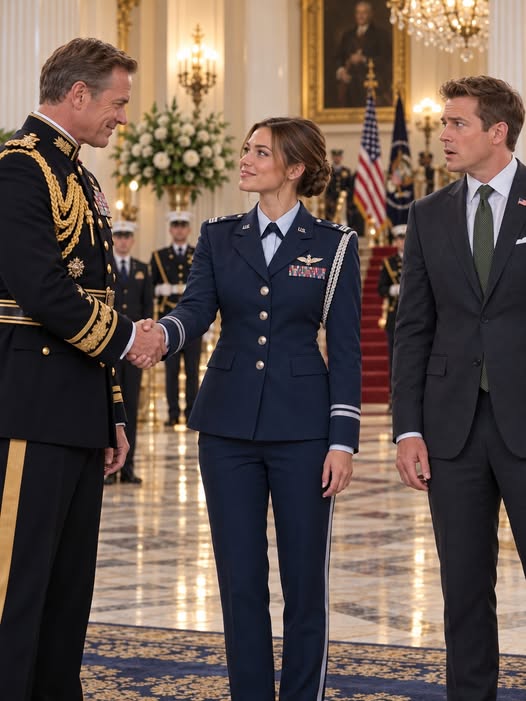
The admiral came to a stop in front of me and extended his hand.
""Colonel Sloane Merrick. What a privilege to finally meet you face-to-face.""
My husband's shoulders instantly stiffened.
I accepted the admiral's handshake. ""The privilege is mine, sir.""
""The President specifically requested that we inform him as soon as you arrived.""
Mitchell inhaled so abruptly that even the hostess turned to glance at him.
A protocol officer approached us, carrying a black folder pressed against her chest. She greeted me with a warm smile before turning toward my husband with the measured courtesy people use when they're politely making it clear that a conversation is over.
""Sir, your designated seating is in this direction.""
Mitchell took a step forward. ""My wife is attending with me.""
""Colonel Merrick has been assigned separate seating, sir.""
That single sentence accomplished something three years of disagreements had never managed. It brought the truth into the open without anyone needing to raise their voice.
I accompanied the admiral toward the East Room. When we reached the entrance, I glanced back one time. Mitchell remained motionless beside the checkpoint, one hand suspended halfway in the air, almost as if his refusal to comprehend what was happening might somehow prevent it.
Long rows of gold chairs filled the room. Senior military officers rose as I passed them. An Air Force general greeted me with a smile that suggested he'd been hearing about me for quite some time.
""So you actually do exist,"" he remarked under his breath.
""Only on my better days, sir.""
He laughed and motioned toward a chair in the front row.
Then the President entered. Everyone rose to their feet. Applause echoed beneath the chandeliers. I kept my hands resting together in my lap.
The President began his remarks. He spoke about the work performed quietly, beyond public recognition. About the people who prepare for the most difficult day of someone else's life, making certain that day ends with those people returning safely home. About heroes whose names rarely appear in the headlines.
Mitchell was sitting eight rows behind me. And for the first time in our three years together, he was genuinely paying attention.
Then the President turned his gaze toward the front row.
His eyes settled directly on me.
And just before speaking my name, he paused.
---
Related Stories