Chapter 4: The Ledger Under the Floorboards
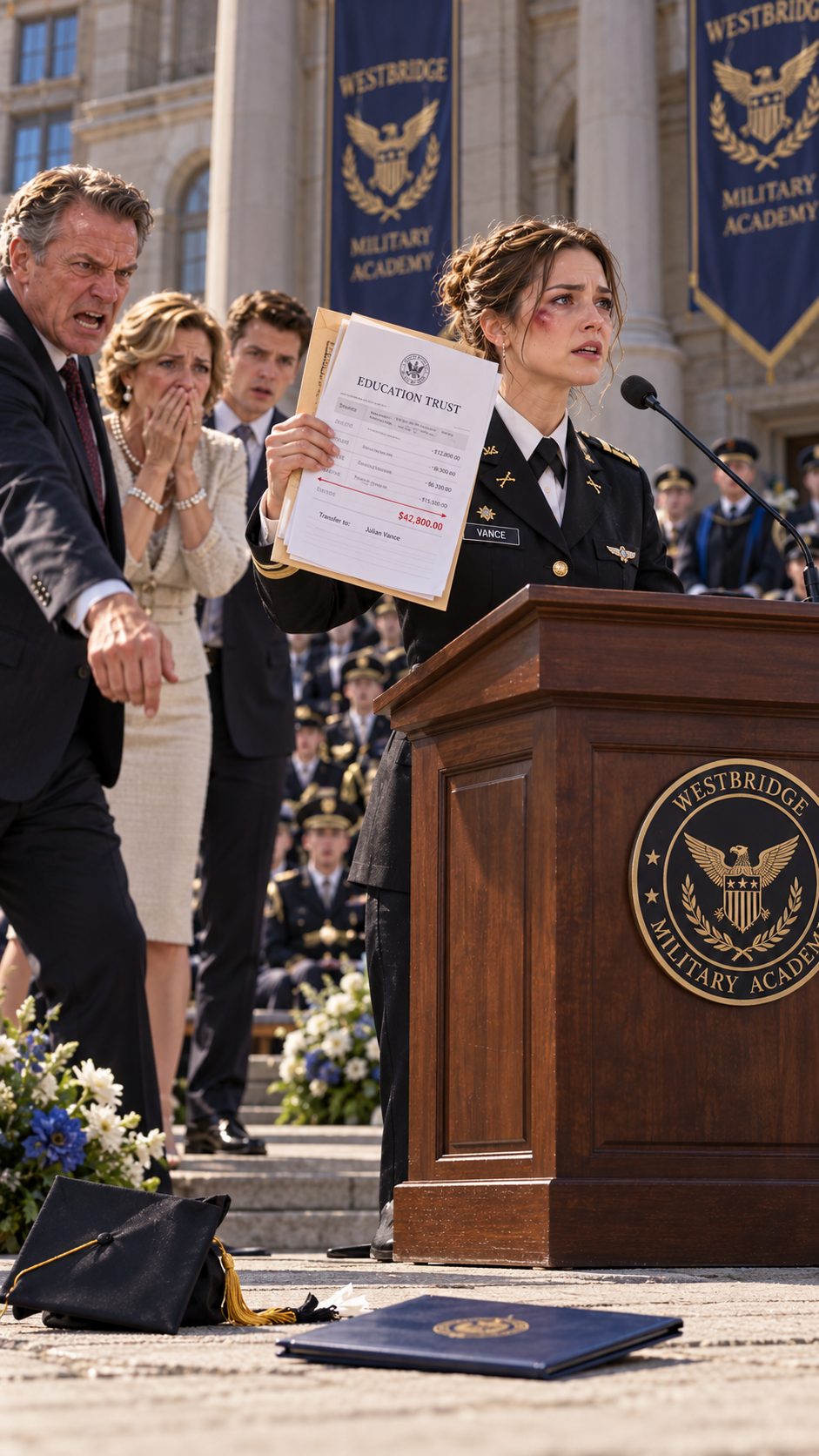
The silence in the drawing room was colder than the rain running down the windowpanes.
Paige had told me once that every military institution had a paper guillotine in the basement—an administrative clause so obscure, so technical, that no officer could survive it if command decided to pull the cord.
A childhood stress fracture.
Age fourteen. Falling from a timber rail in the south pasture. Arthur had taken me to a civilian clinic in Staunton instead of the base hospital, paying cash so it wouldn't appear on my dependent records.
*“A Vance doesn't have broken bones on record,”* he had told me back then, his hand heavy on my shoulder as the doctor wrapped the cast. *“We heal, and we keep our mouths shut.”*
Now, Arthur looked down at the carpet, his hands limp at his sides. He had given Holloway the ammunition twelve years ago, probably over drinks at the Army-Navy Club, trading away his daughter's medical history for an extended credit line.
""You knew about that, didn't you, Dad?"" I asked.
Arthur didn't answer. He couldn't. He looked like an empty coat hanging on a peg.
""Lieutenant Vance,"" Holloway said, his voice flat, professional, and entirely devoid of malice. That was what made it terrifying; he wasn't angry. He was simply moving assets across a balance sheet. ""I don't wish to terminate a promising career. You graduated at the top of your cohort. Your tactical papers on logistics interdiction were exceptional. But Westbridge belongs to this commonwealth, and this ridge belongs to the defense corridor. Sign the release.""
He set a gold-plated pen beside the folder.
I looked at the pen. Then I looked at Julian, who had sunk into the corner armchair, hiding his face in his hands, weeping without a sound. I looked at Victoria, whose posture had relaxed, a small, triumphant curl returning to the edge of her painted mouth.
She thought she had calculated every angle. She thought that because I had worn the uniform, because I had bled for four years to earn the right to stand on that courtyard, the threat of losing my commission would bring me to my knees.
""Where did Grandpa Harold keep his service revolvers, Arthur?"" I asked suddenly.
Arthur blinked, startled by the shift. ""What? In... in the gun room. In the cedar cabinet.""
""No,"" I said, stepping past Holloway toward the small library alcove behind the drawing room. ""Harold never kept functional weapons in an unlocked cabinet. He was third-generation ordnance.""
I walked into the library.
The room was narrow, smelling of old leather and linoleum. In the corner sat Harold's heavy oak field desk—the one he had carried through two campaigns in the Pacific, its brass corners battered and green with verdigris.
Victoria followed me to the doorway, her heels clicking sharply. ""Audrey, stop this childish performance! Sign the document so we can settle this!""
I ignored her.
I knelt beside the desk, running my fingers along the bottom skirting board beneath the kneehole.
When I was twelve years old, Harold had sat me on his knee right here, showing me how to field-strip an M1911 with a single punch tool. *“A defensive position is only as good as its secondary escape route, Audrey,”* he had told me, his rough, tobacco-stained thumb pressing against the hidden brass release beneath the center drawer. *“If they breach the wire, you don't surrender the logbook. You pull the primary pins.”*
My thumb found the small, recessed lever.
*Click.*
The false bottom of the center drawer popped upward by a quarter of an inch.
Holloway had followed me into the library now, standing just behind Victoria, his expression tightening for the first time.
I pulled the oak insert free.
Inside lay no weapons. There was only a green cloth-bound ledger, stamped with the gold crest of the United States Army Corps of Engineers, dated June 1954.
And tucked inside the ledger was a set of architectural blueprints bearing the blue stamp of the Department of the Interior.
I opened the blueprint across the desk.
The title block was clear: *HIGH CHIMNEYS GEOLOGICAL SURVEY // SUB-SURFACE CONVEYANCE.*
""What is that?"" Victoria demanded, her voice rising an octave, the shrill edge returning.
""Harold didn't leave this land to the Vance trust because of ancestral sentiment, General,"" I said, looking up at Holloway. ""He left it because in nineteen-fifty-three, while running the preliminary core drillings for the interstate highway, the Corps of Engineers discovered a massive deposit of industrial-grade silica quartz beneath the north ridge.""
Holloway didn't move. But his eyelids flickered once.
""The communication relay station was never for defense communications, was it, sir?"" I said, standing up with the green ledger in both hands. ""The federal acquisition was a front. Your private investment syndicate in Wilmington had already negotiated a lease option with an extraction corporation based in Charlotte.""
I turned to Arthur, who was standing in the doorway behind his wife, looking bewildered.
""Grandpa Harold didn't disinherit you because he hated you, Arthur,"" I told my father. ""He disinherited you because he knew you were too weak to resist selling the quartz. The will contained a restrictive covenant: if any Vance attempted to commercialize the sub-surface minerals, the entire five hundred acres was to be transferred immediately to the Virginia Conservation Trust as a permanent public wilderness preserve.""
Victoria lunged forward, her hands clawing for the blueprints. ""Give me that!""
I caught her wrist.
I didn't strike her. I didn't raise my voice. I simply applied three pounds of pressure to the radial nerve—the basic compliance hold taught in the first week of military police training.
Victoria gasped, dropping to her knees on the braided rug, her fingers instantly splaying open.
""Audrey!"" Arthur shouted, taking a step forward.
""Stay where you are, Colonel,"" I commanded.
The rank snapped like a whip in the narrow room. Arthur froze, his boots planted on the floorboards, unable to overcome thirty years of ingrained military hierarchy.
I looked at General Holloway.
""The restrictive covenant was registered with the state supreme court in nineteen-sixty-two, General,"" I said, holding the green ledger against my chest. ""Before you were even commissioned. Which means your private lease in Delaware is worth less than the paper it's printed on.""
Holloway took a slow, deep breath. He took off his glasses, polished the lenses with the corner of his silk tie, and put them back on.
""You have Harold’s mind, Lieutenant,"" Holloway murmured. ""A pity you don't have his sense of self-preservation.""
""My self-preservation is intact, sir,"" I replied.
""Is it?"" Holloway reached into his pocket and pulled out his cell phone. He dialed a four-digit extension. ""Captain Miller. This is the Superintendent. Transmit the administrative separation packet for Second Lieutenant Vance to the Department of the Army personnel board in Alexandria immediately. Charge code: Fraudulent Enlistment under Article Eighty-Three.""
---
Related Stories