Chapter 2: The Red Folder
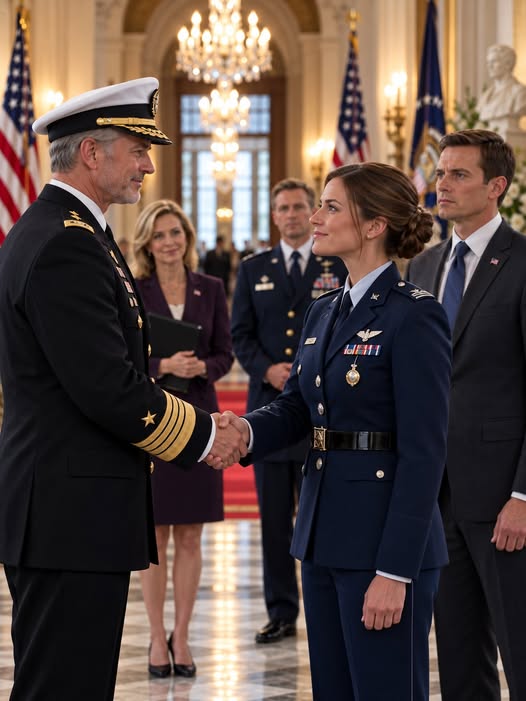
The Treaty Room on the second floor of the White House was thick with history and quiet authority.
Beneath the portrait of Ulysses S. Grant, Secretary of Defense Donald Sterling sat at a polished mahogany table, reading glasses resting low on the bridge of his nose. Beside him stood Lieutenant General Thomas Hayes, the Army Deputy Chief of Staff for Personnel.
When the heavy door closed behind Mitchell and me, the muffled hum of the reception below vanished completely.
""Colonel Merrick,"" Secretary Sterling said, taking off his glasses and offering a tired, genuine smile. ""Take a seat. Mitchell, you too.""
We sat. Mitchell remained on the edge of his leather armchair, his posture so stiff he looked as though he were awaiting a court-martial. His eyes kept darting toward the crimson-sealed folder resting on the blotter between us.
""Sloane,"" Secretary Sterling began, leaning back. ""First, congratulations. The citation tonight only scratched the surface of what you accomplished in East Africa, but it was necessary to put your flag on the field. You've operated in the shadows for five years. That ends tonight.""
""Thank you, Mr. Secretary,"" I said.
""As General Campbell likely hinted downstairs,"" Sterling continued, ""the President has submitted the upcoming brigadier general promotion list to the Senate Armed Services Committee. Your name is at the top of the logistics slate.""
Beside me, Mitchell let out a small, involuntary gasp.
A brigadier general. One star.
In twenty-four years of service, Mitchell had lived and breathed for that single silver star. He had shaped his career around it—taking staff positions, cultivating relationships with retired congressmen, polishing his record until it gleamed.
""That's... that's extraordinary, sir,"" Mitchell stammered, trying desperately to inject warmth into his voice, though his eyes were glazed with a hollow, burning shock. ""Sloane... Colonel Merrick has worked very hard.""
Secretary Sterling didn't acknowledge Mitchell's praise. He pulled the red-sealed folder toward himself and unfastened the brass clasp.
""Which brings us to the administrative portion of this meeting,"" Sterling said, his tone shifting into the crisp, lethal register of a senior official delivering hard news. ""General Hayes, if you would.""
General Hayes picked up a single sheet of paper from the file.
""Colonel Ashcroft,"" Hayes said, looking squarely at Mitchell. ""For the past six months, you have been under consideration for command of the 16th Sustainment Brigade in Baumholder, Germany.""
Mitchell’s chin lifted by half a fraction. A tiny ember of his old confidence flickered in his eyes. ""Yes, General. I’ve completed the prerequisite command coursework and my brigade packet was forwarded with senior endorsements.""
""It was,"" Hayes agreed. ""However, pursuant to Department of Defense Directive 1315.07 regarding joint-spouse flag officer assignments, the appointment of an active-duty spouse to the rank of brigadier general triggers an immediate conflict-of-interest review for sensitive operational commands.""
Mitchell froze. The ember in his eyes died instantly.
""A... conflict review, sir?""
""Colonel Merrick’s nomination is for Director of Logistics for United States European Command,"" Hayes stated plainly. ""Headquartered in Stuttgart. The 16th Sustainment Brigade falls directly under her operational procurement and allocation authority.""
The air in the Treaty Room went utterly still.
I looked at Mitchell.
The reality was crushing him in real time.
If I accepted the promotion to brigadier general and took the EUCOM desk, military regulations strictly forbade my spouse from commanding a subordinate brigade within the same operational theater. It was basic nepotism prevention.
""Sir,"" Mitchell began, his voice pitching higher, cracking on the consonants. ""My packet for the 16th Brigade has been in the works for three years. It’s the command assignment required for my own general officer board next fall. If I don't take that brigade—""
""If you don't take the brigade, Colonel,"" Secretary Sterling interrupted, his voice calm, flat, and absolute, ""you will be reassigned to a senior staff advisory role at the Pentagon. Managing facility infrastructure.""
A desk job.
Managing buildings.
The very category of work Mitchell had spent three years mocking over Sunday dinners.
""Mr. Secretary,"" Mitchell pleaded, his hands coming off his knees in an uncharacteristic, frantic gesture. ""There must be an alternative. Sloane could take a domestic billet! Northern Command in Colorado! Or an academic chair at the National Defense University! She doesn't need to go to Stuttgart!""
I sat completely still, watching my husband.
He hadn't asked what the European Command assignment meant to me. He hadn't asked about the mission, the strategy, or the two decades of sacrifice that had put my name at the top of the President’s desk.
In the span of thirty seconds, his only instinct had been to ask the Secretary of Defense to bury my career in an academic library so he could have his brigade.
Secretary Sterling stared at Mitchell for five long seconds. The silence was deafening.
""Colonel Ashcroft,"" Sterling said, each word falling like a drop of freezing water. ""Colonel Merrick did not request the European Command assignment. The Supreme Allied Commander requested *her*. By name. Because when the eastern logistics corridor needs to be rebuilt, he wants the officer who pulled four hundred people out of a burning desert, not a politician.""
Sterling closed the folder with a dry, sharp snap.
""The decision rests entirely with Colonel Merrick,"" Sterling said, turning his eyes to me. ""Sloane. The Senate committee hearings begin in three weeks. You have forty-eight hours to accept the nomination packet, or decline and request a non-deployable domestic assignment.""
I looked from the Secretary to the red folder, then slowly turned my head toward my husband.
Mitchell’s face was twisted in a silent, desperate plea. For the first time in our marriage, he was looking at me not as an accessory to his ambition, but as the sole arbiter of his future.
""Thank you, Mr. Secretary,"" I said, my voice steady, clear, and quiet. ""I will have my answer on your desk by Monday morning.""
We stood. The formal salutes were exchanged.
As we stepped out of the Treaty Room into the quiet second-floor corridor, Mitchell grabbed my wrist, pulling me toward the railing overlooking the Grand Staircase.
""Sloane, you can't do this,"" he whispered, his eyes wide and bloodshot. ""My mother has already rented a house in Germany for the change-of-command ceremony. If I lose that brigade, my career is finished. You have to turn it down.""
I looked down at his hand gripping my wrist, then lifted my eyes to his face.
""My car is waiting outside, Mitchell,"" I said softly, disengaging his fingers with a single, firm turn of my arm. ""Take an Uber home.""
---
Related Stories