Chapter 1: The Cold Front on Maple Street
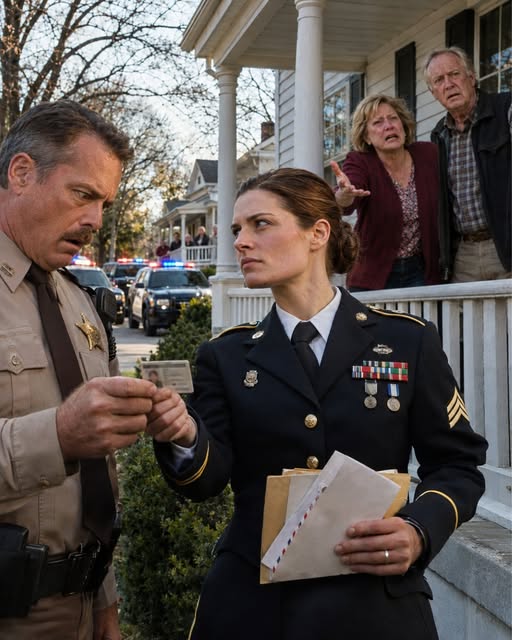
The blue and red strobe lights painted the peeling white siding of my childhood home in erratic, violent strokes.
Sheriff Thomas Miller lowered his shoulder mic, but his eyes never left the thick sheaf of papers in his calloused hands. He was fifty-eight years old, a former Marine who had known my father, Arthur, since high school. He had attended our Fourth of July barbecues. He had watched me ride my bicycle without training wheels down this very sidewalk.
Behind him, two deputies kept their hands unlatched near their holsters, their postures rigid and uncertain as they stared at the sharp gold chevrons on my sleeve and the pristine, three-tiered ribbon rack pinned over my heart.
Across the lawn, Mrs. Gable—who had lived next door for thirty years—stepped off her porch, wrapping her cardigan tight around her chest, staring openly. Down the block, another neighbor pulled out a phone, aiming the camera lens at the cruisers.
""Sheriff,"" my father stammered, stepping halfway off the porch, his hand white-knuckling my mother’s wrist. ""You don't understand. She stole those clothes. She’s mentally unstable. You know what she did before she ran away four years ago—""
""Quiet, Arthur,"" Sheriff Miller said. His voice was dangerously soft, the tone of a veteran who could smell a fabrication from fifty paces.
Miller stepped two paces toward me, holding out my laminated Common Access Card. His thumb ran along the raised seal of the Department of Defense.
""Sergeant Parker,"" Miller said, his gaze locking with mine. ""Your active service record indicates an honorable discharge processed out of Fort Campbell seventy-two hours ago. Military Occupational Specialty: 68W, Combat Medic.""
""Yes, sir,"" I answered, keeping my chin level and my feet planted at shoulder width. The desert wind in Al-Asad had taught me to stand firm when the world shook, and I refused to sway on my own front lawn. ""Three deployments. Two combat action badges. One Army Commendation Medal with valor device.""
A murmur broke out among the neighbors lining the street. The cameraman from the county news van stepped forward onto the curb, his lens swinging directly from the sheriff’s badge to my medals.
My mother, Diane, let out a high, strangulated shriek that sounded like tearing silk.
""It's fake!"" she screamed, tearing her arm free from my father's grip. Her face was mottled with blotches of bright crimson, her carefully coiffed Sunday church curls unraveling in the cool autumn breeze. ""She forged it! She went to prison for grand larceny, Sheriff! You remember the court notice! You remember the shame she brought on our family!""
""Diane,"" Mr. Greer’s raspy voice cut through the street.
The old mail carrier had stepped out of his battered pickup truck, his worn leather postman’s satchel still slung across his frail shoulder. He walked with a heavy limp—a souvenir from a mortar shell in Da Nang—and stopped right beside the sheriff.
""You stamped twenty-six envelopes with my ink pad, Diane,"" Mr. Greer said, his eyes hard as flint behind his thick glasses. ""Every time that girl wrote to you from a forward operating base, you handed the letters right back to me at the mailbox. You told me to return them to sender. You looked me in the eye and said, 'We don't harbor felons in this house.'""
""She is a felon!"" Diane shrieked, backing toward the front door. ""She stole from us! She stole our life savings!""
""Sheriff,"" I said, my voice steady, carrying clearly across the quiet suburban street. ""If I was convicted of grand larceny, where is the county docket? Where is the Department of Corrections inmate number? Where is the sentencing record?""
Sheriff Miller didn't answer right away. He turned the envelope in his hand—the final letter I had sent three weeks before boarding the transport plane in Kuwait. Across the center, written in my mother's neat, looped handwriting beneath the red postal stamp, was a single spiteful sentence: *Do not contact this residence again, criminal.*
Miller turned his head toward his senior deputy. ""Hanks. Run the name. Emily Ann Parker. Run it through NCIC, the state registry, and the county clerk’s database. Every jurisdiction from here to Chicago.""
Deputy Hanks hurried back to his cruiser, pulling the door shut against the chill.
My father took another step backward, his boots scraping against the bottom step of the porch. His skin was the color of curdled milk. For twenty years, Arthur Parker had been an elder at First Baptist, a respected insurance adjuster who prided himself on moral rectitude and ledger-clean balance sheets. He looked smaller now, hollowed out inside his windbreaker.
""Arthur,"" Diane hissed, grabbing his elbow with claw-like fingers. ""Get inside. Call Judge Miller’s office. Call our lawyer.""
""Nobody is going inside,"" Sheriff Miller ordered, turning on his heel to face them directly. ""Arthur, keep your hands where my deputies can see them.""
From inside the cruiser, the radio clicked, followed by the dry, tinny crackle of dispatch through the open cruiser window.
Deputy Hanks stepped out of the vehicle holding a printed carbon clipboard. He walked slowly across the gravel, his expression completely blank, stopping beside the sheriff.
""Well?"" Miller asked.
Hanks looked at my mother, then at my father, and finally down at the clipboard.
""There's no criminal record on file for Emily Ann Parker, Sheriff,"" Hanks said, his words falling like lead sinkers into the evening air. ""No arrests, no warrants, no court dates. But there is an active civil court proceeding filed under her Social Security number.""
My heart gave a strange, violent jolt. ""A civil proceeding? For what?""
Deputy Hanks swallowed hard, his eyes flickering toward the gathering neighbors.
""An affidavit of presumptive death, Sergeant,"" Hanks said quietly. ""Filed thirty-six months ago by Diane and Arthur Parker. Stating you had disappeared while fleeing criminal indictment, authorizing the expedited distribution of a two-hundred-and-fifty-thousand-dollar survivorship policy from your late grandfather’s estate.""
---
Related Stories